What Is the Best Lithium Battery for a Golf Cart?
Choosing the best Lithium Battery For Golf Cart starts with your cart, not a flashy capacity claim. Check the required voltage, battery compartment dimensions, terminal layout, and the charger’s compatibility. A battery that cannot fit or charge correctly is not a good upgrade. Fit comes first.
For many owners, lithium iron phosphate batteries are worth comparing because they can offer lower weight and steady power delivery. Still, performance depends on the pack’s usable capacity, battery management system, manufacturer support, and warranty terms. Think about your real routes: a flat nine-hole course needs different range than hilly paths, extra passengers, or frequent accessory use. Not just range. A clear specification sheet and responsive technical support matter, too.
This guide looks at practical ways to compare battery options, including capacity, installation requirements, charging, expected service life, and cost over time. It also explains where lithium may not suit an older cart without electrical checks or compatible charging equipment. Small details count. A few missing measurements can turn a promising purchase into a frustrating return. There is no perfect pick for every cart, and advertised range can be optimistic. Verify the manufacturer’s figures against your cart model and usage, then choose a battery that meets those needs without paying for capacity you will rarely use.
How Lithium Batteries Power a Golf Cart
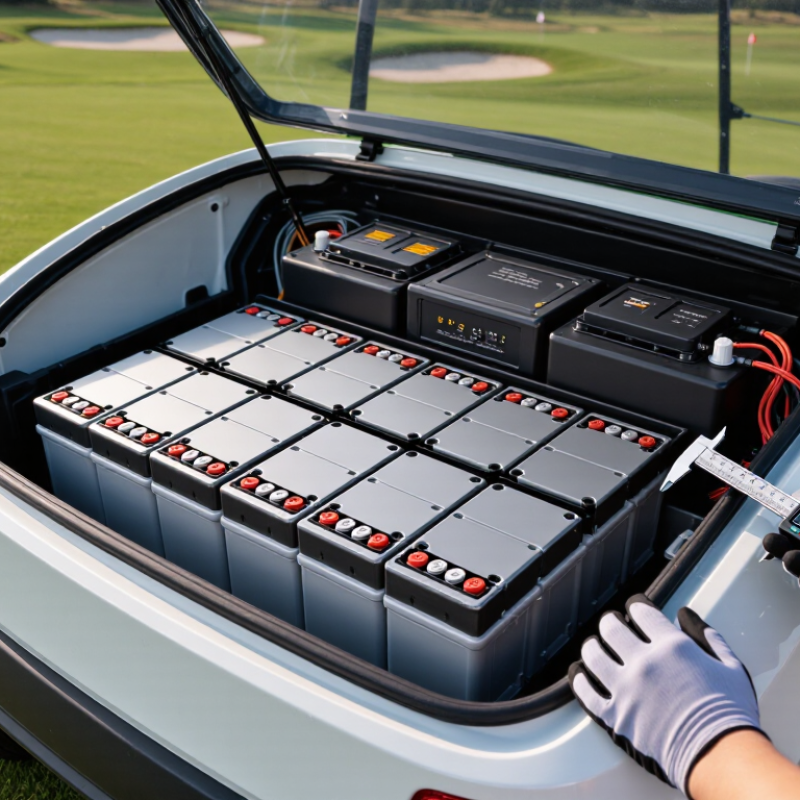
A lithium battery powers a golf cart by storing direct-current electricity in connected cells. When the driver presses the accelerator, the battery sends current to the motor controller. The controller regulates that power, and the motor turns the wheels. Simple in principle. A battery management system monitors cell voltage, temperature, and current to help protect the pack during use and charging.
The cart’s voltage must match the battery’s rated voltage, and the pack must supply enough current for the motor’s demands. A mismatch can cause faults or poor performance, so check the cart manual and have a qualified technician confirm compatibility. Lithium packs often maintain steadier voltage as they discharge than lead-acid batteries do, which can help the cart feel more consistent. That matters on a long hill. Still, range depends on passenger weight, terrain, tire pressure, speed, and accessory use—not just the capacity printed on a specification sheet.
Charging and installation also shape how the battery performs. Use a charger designed for the pack, and follow its temperature limits; charging in very cold conditions may be restricted. Secure the battery firmly, since bumps can loosen connections over time. Capacity numbers can look reassuring, but they do not tell the whole story. The right choice also depends on the cart’s electrical system and how far it travels between charges.
What Is the Best Lithium Battery for a Golf Cart? – How Lithium Batteries Power a Golf Cart
| Battery chemistry | Typical 48V-class configuration | Typical cycle life* | Key characteristics | Golf-cart suitability |
| LiFePO₄ (LFP) | Often 16 cells in series; 51.2V nominal and up to about 58.4V when fully charged | About 2,000–5,000 cycles | Generally strong thermal stability, long service life, and good usable capacity. Requires a compatible battery-management system (BMS). | Best all-around choice for many carts, provided the cart’s controller, charger, and wiring support the pack’s voltage. |
| NMC (lithium nickel manganese cobalt oxide) | A 48V-class pack may use a different series-cell count than LFP; nominal and full-charge voltages vary by design. | About 1,000–3,000 cycles | Typically offers higher energy density, but pack voltage and thermal-management requirements depend on the design. | Can suit carts where lower battery weight or compact size is a priority. Confirm the exact voltage range and BMS compatibility before installation. |
| LTO (lithium titanate) | Pack configuration varies; use the manufacturer’s stated nominal and maximum charge voltages. | Often several thousand cycles; some designs are rated above 5,000 | Known for fast charging and long cycle life; usually has lower energy density and can cost more than common alternatives. | A specialized option for demanding duty cycles. Check availability, cost, and compatibility with the cart’s charging system. |
Practical recommendation: For many golf carts, a properly sized LiFePO₄ pack is the best balance of cycle life, usable energy, and thermal stability. Match the pack’s nominal and maximum voltage to the cart, and use a compatible charger and BMS. Actual range depends on battery capacity, terrain, speed, load, temperature, and vehicle condition.
*Cycle-life figures are typical ranges, not guarantees. Results vary with cell quality, operating temperature, charge and discharge rates, and depth of discharge.
Which Battery Specifications Matter Most?
For a golf cart, the best lithium battery is not simply the one with the highest amp-hour rating. Start with voltage: the pack must match the cart’s electrical system, such as a 36- or 48-volt setup. A mismatch can prevent proper operation or damage equipment. Check the label.
Capacity matters too. Amp-hours (Ah) indicate how much charge a battery can store, while voltage multiplied by amp-hours gives a rough energy estimate in watt-hours. More capacity may extend driving time, but hills, passenger weight, tire pressure, and driving speed all affect real-world range. A cart carrying four people uphill uses energy differently from one cruising on flat paths.
Look beyond capacity. Confirm the battery’s continuous and peak current ratings can handle the cart’s motor, especially during acceleration or hill climbs. The battery management system should protect against conditions such as overcurrent and excessive temperature. Check its specified operating limits; cold-weather charging restrictions can be easy to overlook. Charger compatibility is essential, too, so verify that the charger’s voltage and charging profile suit the battery. Finally, compare dimensions and weight with the existing battery compartment. Specifications can look perfect on paper, yet a case may not fit or its terminals may sit in the wrong place. Cycle-life figures also deserve context: ask what depth of discharge and test conditions were used. Those details can change the meaning of the number.
How to Match Battery Voltage and Capacity to Your Cart
A golf cart’s battery voltage must match its electrical system, not just fit beneath the seat. Many carts use 36 or 48 volts, but check the manual or existing battery label before choosing a replacement. Confirm the lithium pack is rated for that system voltage. Its nominal voltage and fully charged voltage may differ from what an older charger expects. Check compatibility with the controller, charger, and battery-management system, too. Small mismatch, big trouble. An incompatible setup can cause charging faults, reduced performance, or premature component wear.
Capacity, measured in amp-hours (Ah), affects runtime. Estimate how far you drive between charges, then allow some reserve rather than choosing only for ideal conditions. A cart carrying four adults up rolling paths uses energy differently from one cruising on level ground. Real use is messier than a catalog estimate. Terrain, passenger weight, tires, and lights all matter. Also check that the battery’s continuous current rating can support the cart’s demands, especially during hill climbs. A larger-capacity pack may offer longer runtime, but verify its dimensions, mounting, and charger requirements before purchase. If the specifications are unclear, ask a qualified cart technician to confirm the match.
How Battery Design Affects Safety, Lifespan, and Charging
The best lithium battery for a golf cart is not just the one with the highest capacity. Pack design affects how safely cells work together, how long they last, and whether charging stays controlled. A battery management system should monitor cell voltage and temperature, balance cells, and interrupt charging or discharge when limits are reached. A secure enclosure and correctly rated protection matter too. Small details, but important.
Chemistry is only part of the choice. The International Energy Agency’s Global EV Outlook 2024 reports that lithium iron phosphate batteries held about 40% of the global electric-car battery market in 2023. That figure describes cars, not golf carts, but it shows why this chemistry is widely considered for durability and thermal stability. Actual service life still depends on pack quality, heat, discharge depth, and charging habits. A tidy cycle-life number can hide those conditions.
Tips: Match charger voltage and charging profile to the battery pack; do not assume an old lead-acid charger is suitable. Check the cart manual, and avoid charging a cold battery unless its maker permits it. Keep terminals dry and inspect cables for looseness or heat marks. Even a well-designed pack can be let down by poor installation.
What Is the Best Lithium Battery for a Golf Cart?
How battery design affects safety, lifespan, and charging
Lithium iron phosphate (LFP) batteries typically offer more charge cycles than other common golf-cart battery types. These ranges are estimates: actual lifespan depends on depth of discharge, temperature, maintenance, and charging habits. For lithium batteries, a well-designed battery management system (BMS) and a charger matched to the battery are important for safe charging. No battery chemistry is risk-free.
How to Compare Batteries for Different Golf Cart Needs
Choosing a golf-cart battery starts with the work the cart actually does. A flat, short course needs less usable capacity than a hilly property with several daily trips. Compare voltage, amp-hour capacity, continuous discharge current, and the battery’s weight. A large capacity number alone does not guarantee enough hill-climbing power.
The U.S. Department of Energy and Sandia National Laboratories’ 2013 Electricity Storage Handbook gives typical round-trip efficiency ranges of 85–98% for lithium-ion systems and 75–85% for lead-acid systems. These are broad storage benchmarks, not golf-cart test results. Actual range depends on terrain, load, temperature, tires, and driving habits.
Cold changes things. So does carrying four passengers.
Check that the battery’s voltage matches the cart and that its battery-management system supports the expected current. Confirm charger compatibility, too; a mismatched charger can undermine performance. For frequent use, compare cycle-life ratings and warranty conditions, while checking how those ratings were tested. For occasional, gentle trips, paying extra for capacity you rarely use may not make sense. Measure your route, passenger load, and charging routine first. Real routes are messy, and published range figures can be optimistic.
