Top Mattress Display Racks for Retail Stores

A mattress is difficult to judge from a photograph alone. Shoppers want to see its height, feel the surface, and compare nearby models without squeezing past clutter. A well-planned Mattress Display Rack can make those small decisions easier. It can also help staff keep floor samples visible and the sales area orderly.

For this introduction, the quoted specialist is fictional, not a verified industry source. Retail-fixture specialist Evan Cole offers this illustrative principle: “A good mattress display invites a closer look without making the aisle feel smaller.” The idea is practical, though not a guarantee of higher sales. A rack that looks impressive on paper may still obstruct movement or hide product labels in a busy store.

This guide explores display rack options for different retail layouts, from compact showrooms to larger mattress floors. It considers access, stability, visibility, and how shoppers compare models at close range. Small details matter: the position of a sample edge, the clearance beside a rack, even a price card facing the wrong way. There is no single best setup. Store traffic, mattress sizes, and staff routines all change the answer. Some recommendations may need testing on the sales floor. That is worth admitting.
Top Mattress Display Racks for Retail Stores

What Mattress Display Racks Are and How Retailers Use Them

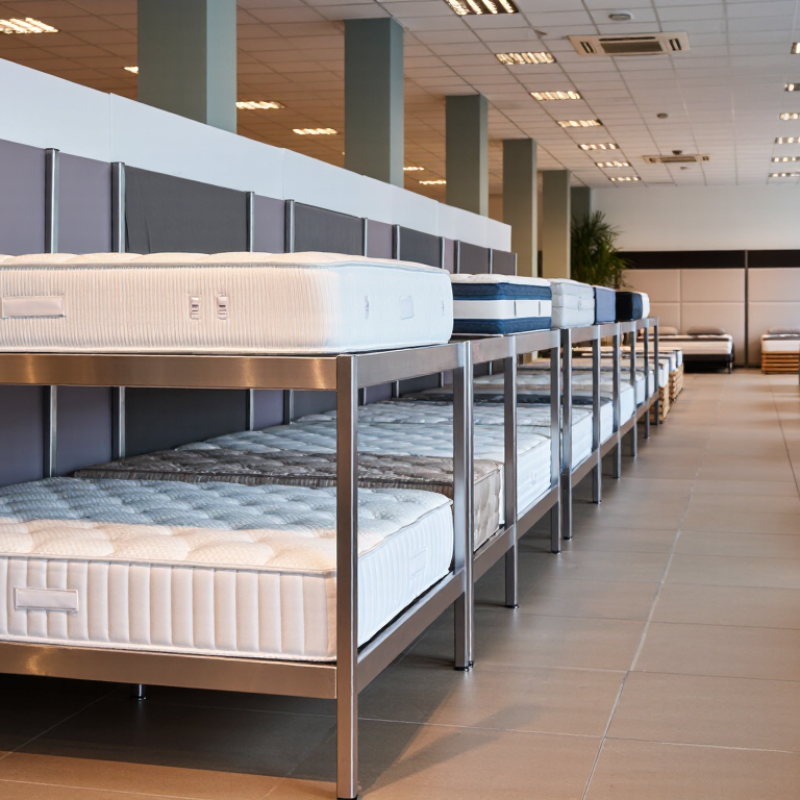
A mattress display rack is a purpose-built frame that presents mattresses upright or at an angle, making product layers and profiles easier to inspect. Some racks hold a single sample; others arrange several models in a compact row. Retailers use them to show firmness options, compare thicknesses, and keep floor samples organized. Small labels can identify materials and feel. Close-up details matter.

A well-planned display leaves room for shoppers to walk around, press the surface, and sit on the edge. Staff can use the rack to guide comparisons without moving heavy mattresses repeatedly. In smaller stores, vertical presentation can also free floor space. But a crowded rack can make choices harder, not easier. That trade-off deserves attention.

The Global Wellness Institute’s 2024 Global Wellness Economy Monitor estimated the sleep economy at $585 billion in 2023. This broad category includes more than mattresses, so it is not a measure of rack sales. It does show the scale of interest in sleep-related products. A rack should support careful comparison, not promise better sleep. Check stability, accessible labels, and clear pathways during regular floor reviews. Display fixtures help, but they cannot replace accurate product information or knowledgeable staff.

Common Rack Types for Showcasing Mattresses in Stores

Retail mattress racks generally fall into a few practical types. Low platform racks hold a mattress flat, often on a simple frame that resembles a bed. Shoppers can sit on the edge and test the feel without climbing onto a tall display. Space matters. These racks need enough floor area for comfortable access and clear walkways.

Vertical racks store mattresses upright, making them useful where floor space is limited. They can display several sizes, but shoppers may find it harder to compare comfort without a sample laid flat. Angled or adjustable display racks offer a middle ground: they show the mattress surface while keeping the footprint smaller. Check that each unit supports the mattress securely and does not wobble when customers press or lean on it. Not always.

The right setup depends on store layout, mattress weight, and how customers shop. Measure doorways and aisles before choosing a rack; a display that fits on paper may block a busy path. Leave room for people to move around each sample, and place size or material details where they can be read easily. A wall of identical upright mattresses can look tidy, yet make comparison harder. Mixing rack types may help, though it can also make the showroom feel less consistent.

Key Features That Affect Rack Safety and Usability

Top Mattress Display Racks for Retail Stores

Key Features That Affect Rack Safety and Usability

A mattress rack should support its load without rocking, tilting, or forcing staff to lift at an awkward angle. Check its stated capacity against the heaviest mattresses you plan to display, not just the average unit. A wide, stable base helps resist tipping, especially when a mattress is removed from one side.

Small detail, big difference.

Inspect welds, joints, and exposed edges; rough spots can snag fabric or hands. Retaining bars or side supports keep stacked mattresses from shifting, but they should not block labels or make removal difficult. Adjustable arms can fit different mattress thicknesses, though loose adjustment points may need frequent checks.

If the rack has casters, choose locking wheels and test them on the actual floor.

Test them. A lock that slips on polished tile is not much help.

Leave enough aisle space for people to turn safely, even when a mattress is pulled out.

Usability also depends on how staff restock the display. Handles, reachable fasteners, and clear access to each mattress reduce unnecessary pulling and twisting. Confirm the rack can be cleaned around and inspected without moving several heavy products.

That is easy to overlook.

I would watch a real restocking run before approving a layout; measurements on a plan may miss a tight corner or blocked sightline. Recheck stability after moving the rack, since floor slopes and uneven loads can change how it behaves.

How to Choose Racks for Store Size and Mattress Range

Choosing mattress display racks starts with a floor plan, not a product list. Measure each aisle, doorway, and turning area, then mark the space needed to pull a mattress forward for viewing. In a compact store, vertical or wall-side displays can preserve walking room. Measure twice. A crowded layout may fit more beds on paper, but shoppers need space to compare them comfortably.

Match the rack style to the range you actually sell. A store carrying several sizes may need adjustable supports or clearly separated bays for twin, queen, and king mattresses. If models vary in thickness or weight, check the rack’s stated capacity and support points before purchasing. Ask staff to test how easily a display moves and resets. Small details matter, like whether a corner catches fabric.

Leave room for growth, but avoid buying capacity you cannot use. A narrow showroom with a few carefully spaced displays may work better than a dense row of frames. For larger stores, group mattresses by size or feel, and keep labels visible from the aisle. One imperfect part of planning: sales forecasts can change, so a fixed layout may soon feel awkward. A few flexible bays can help, provided they remain stable and easy to inspect.

Top Mattress Display Racks for Retail Stores — How to Choose Racks for Store Size and Mattress Range

Use this planning guide to match display capacity to showroom area and mattress assortment. Rack footprints and capacities are estimates; confirm dimensions, loading limits, access, and installation requirements with the rack supplier before purchase.

Store Size Suggested Display Rack Approximate Rack Footprint Practical Display Capacity Recommended Mattress Range Layout Considerations
Compact showroom
Under 1,500 sq ft (139 m²)
Single-sided vertical panel rack or compact wall-mounted display About 3–4 ft wide × 2–3 ft deep
(0.9–1.2 m × 0.6–0.9 m)
Typically 3–5 display mattresses per rack, depending on mattress thickness and rack design Prioritize Twin, Full, Queen, and a small number of King models. Use swatches or specification cards for additional options. Place the rack against a wall to preserve floor space. Keep the displayed models easy to compare and avoid blocking entrances or circulation paths.
Small showroom
1,500–3,000 sq ft (139–279 m²)
Wall-mounted panels combined with one compact freestanding rack About 4–6 ft wide × 3–4 ft deep
(1.2–1.8 m × 0.9–1.2 m) per freestanding unit
Approximately 5–8 mattresses per unit, subject to model thickness and spacing Show key comfort levels in Queen, with selected Twin, Full, and King options. Group models by feel or construction. Leave enough room for customers to approach and inspect each display safely.
Medium showroom
3,000–6,000 sq ft (279–557 m²)
Modular double-sided gondola racks with supplementary wall displays About 6–8 ft long × 4–6 ft deep
(1.8–2.4 m × 1.2–1.8 m) per gondola
Approximately 8–14 display mattresses per gondola, depending on configuration Offer a broader selection of Twin, Full, Queen, and King sizes across entry, mid-range, and premium comfort levels. Use clear category signage and keep a continuous route through the display area. Check sightlines and aisle widths against local requirements.
Large showroom
More than 6,000 sq ft (557 m²)
Combination of modular gondolas, wall panels, and dedicated comparison bays About 6–10 ft long × 4–6 ft deep
(1.8–3.0 m × 1.2–1.8 m) per gondola
Approximately 10–16 display mattresses per gondola, depending on rack layout Support a wider range of sizes, comfort levels, materials, and specialty models while keeping the assortment navigable. Create distinct zones by size or product type. Review the full floor plan for customer flow, accessible routes, and safe access to each display.
Any store with frequent assortment changes Adjustable modular rack with repositionable supports or panels Varies by module; measure the installed bay and allow space for handling displayed mattresses Set capacity according to the rack’s rated load and the size and thickness of each mattress Suitable for stores rotating models, sizes, or seasonal displays. Choose components that can be reconfigured without exceeding the rack’s load rating. Keep product labels visible after changes.
Any store emphasizing larger sizes Wide-bay panel rack or floor display designed for larger mattress formats Allow more width and handling space than for Twin or Full displays; confirm exact clearances from product and rack dimensions Capacity may be lower than a comparable bay holding smaller mattresses Reserve floor space for Queen and King models; include California King where it is part of the assortment. Common U.S. mattress dimensions are approximately Twin 38 × 75 in, Full 54 × 75 in, Queen 60 × 80 in, King 76 × 80 in, and California King 72 × 84 in. Actual dimensions can vary by manufacturer.

Planning note: The area bands, rack footprints, and capacity figures are general planning estimates, not universal standards. Measure the showroom and each mattress, verify the rack’s specifications and load rating, and check applicable local building, fire, and accessibility requirements before finalizing a layout.

Display Placement and Care for Long-Term Retail Use

Place mattress display racks where shoppers can compare models without blocking circulation. Keep the busiest demonstration beds near open sightlines, not beside tight corners or queue areas. Maintain clear aisles and follow applicable accessibility and fire-safety requirements. Leave enough room for staff to remove a sample without twisting around another frame. Small layout changes matter.

The U.S. Bureau of Labor Statistics reported that musculoskeletal disorders accounted for 33% of workplace injury and illness cases involving days away from work in 2013. That figure is a practical reminder: moving mattresses repeatedly can strain staff. Store heavier samples on stable, lower positions when the rack design permits. Train employees to lift with a partner, and avoid dragging frames across the floor. A rushed repositioning can loosen fittings.

For long-term use, check bolts, welds, braces, and locking wheels on a regular schedule. Look for bent supports, wobbling feet, sharp edges, or fabric snagging on exposed hardware. Clean rails with a soft cloth and a product compatible with the finish; harsh chemicals may damage coatings. Record repairs and inspection dates. There is no perfect layout. Reassess placement when traffic patterns change, because yesterday’s clear aisle may become today’s bottleneck.

Product Added

Go to Quote Request Form

Continue Product Search