2026 Best Temperature Thermistor Types for Buyers?

Choosing the right Temperature Thermistor starts with the measurement itself. Will the sensor sit against a motor housing, inside a battery pack, or in a small appliance probe? Each location brings different limits for temperature range, response time, accuracy, and durability. Buyers comparing NTC, PTC, and probe-style thermistors should match those limits to the real operating conditions, not just a catalog headline.

Temperature-measurement pioneer William Thomson, Lord Kelvin, wrote, “When you can measure what you are speaking about, and express it in numbers, you know something about it.” His principle remains useful here: check resistance curves, tolerance, calibration data, and lead-wire details before choosing a part. An NTC thermistor often suits precise temperature sensing, while a PTC type can support switching or overtemperature protection. The right answer depends on the circuit and the environment. Small details matter.

This 2026 buyer’s guide compares common thermistor types, materials, packages, and selection criteria. It also considers practical issues such as moisture, vibration, installation contact, and long cable runs. A datasheet may look convincing, yet real performance can shift with mounting and airflow. That is easy to overlook. Some recommendations will still require testing in your own assembly; no guide can remove that uncertainty. Use the comparisons to narrow the field, then verify the chosen sensor under representative conditions.
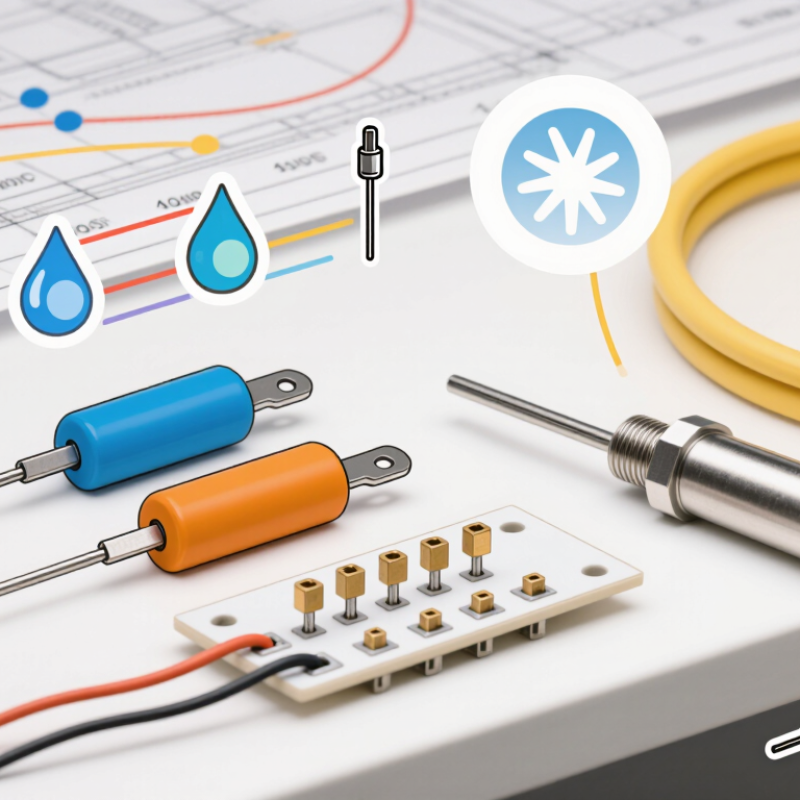
2026 Best Temperature Thermistor Types for Buyers?

How Temperature Thermistors Work and Measure Heat

A thermistor turns heat into a measurable change in electrical resistance. Most temperature probes use NTC elements, whose resistance falls as temperature rises. The response is steep, not perfectly linear. Small changes matter. A common model is R = R₀ expB(1/T − 1/T₀), with temperatures expressed in kelvin. For illustration, a 10 kΩ NTC with a B value of 3,950 K measures about 6.6 kΩ at 35°C, if its resistance is 10 kΩ at 25°C. This is a model-based example, not a universal calibration curve.

NIST Special Publication 250-91, Thermistor Thermometry, describes calibration and resistance-measurement methods; IEC 60539-1 specifies requirements for NTC thermistors. In practice, a circuit measures resistance and converts it to temperature using the sensor’s calibration data. Lead resistance, poor contact, and self-heating can skew the result. Even a small current can warm a tiny sensing bead. That is easy to miss. Placement matters, too: a probe pressed against a metal pipe may report the pipe’s temperature rather than the surrounding air. For reliable readings, match the probe’s response range to the process, keep measurement current low, and verify performance against a reference thermometer. Calibration intervals deserve thought; one schedule does not suit every installation.

The Main Thermistor Types: NTC, PTC, and Silicon

2026 Best Temperature Thermistor Types for Buyers?

The Main Thermistor Types: NTC, PTC, and Silicon

NTC thermistors lose resistance as temperature rises, making them useful for precise measurements across a defined range. They are common in probes, battery packs, and appliance controls. Their response is nonlinear, so the circuit or software must interpret readings correctly. A small bead can react quickly, but its leads and mounting affect real-world performance.

PTC thermistors gain resistance as they warm. This behavior suits overtemperature detection and some current-limiting applications. Silicon temperature sensors often provide a more linear output and may connect directly to digital circuits. Check their operating range, accuracy, and interface requirements; a convenient signal does not guarantee a suitable sensor. I still find mounting details easy to underestimate.

Tips: Match the sensor to the temperature range and environment. Compare tolerance, response time, and package size, then check how it will be attached. A metal housing may slow response. Test a sample in the actual assembly when possible. It takes extra time, but specifications alone can miss small thermal differences.

Key Performance Differences Buyers Should Compare

Choosing between NTC and PTC thermistors starts with how the sensor responds to heat. An NTC thermistor’s resistance decreases as temperature rises, making it useful for continuous measurement and control. Many PTC types show a sharp resistance increase near a switching temperature. That behavior can suit threshold detection, but check the specific curve. Not every PTC responds the same way.

Compare more than the nominal temperature range. Check resistance tolerance, curve accuracy, long-term stability, and response time in the actual mounting position. A small bead may react quickly, yet it can be delicate. A metal probe may handle handling better, but its casing can slow readings. Also check lead insulation and moisture protection. A stated tolerance at one reference point does not guarantee equal accuracy across the full range. Easy to overlook.

Tips: Match the thermistor’s curve to your circuit, then confirm it against the datasheet. Test it in the finished assembly, not only in open air. Keep self-heating in mind: measurement current can warm the sensor and shift its reading. The “best” type depends on the trade-off you can accept.

2026 Best Temperature Thermistor Types: Compare Typical Operating Ranges

Representative temperature ranges for common thermistor constructions (°C). Actual limits vary by component, package, and manufacturer specifications.

Buyer takeaway: NTC thermistors are commonly chosen for continuous temperature measurement, while PTC types are often used for switching or over-temperature protection. Check the individual datasheet for the rated operating range, accuracy, and response time.

How to Choose a Thermistor for Your Application

Choosing a thermistor starts with the temperature range and the job it must perform. For most measurement tasks, an NTC thermistor is suitable because its resistance falls as temperature rises. PTC types behave differently: resistance increases with temperature, often sharply near a designed threshold. That distinction matters. Check the device’s operating range, resistance at a stated reference temperature, tolerance, and resistance curve. A 10 kΩ rating alone does not describe its accuracy across the full range. Look for beta data or a Steinhart–Hart model when converting resistance into temperature.

Next, consider how the sensor will be installed. A small bead may respond quickly in still air, while a probe can better withstand contact or handling. Match the insulation and housing to moisture, vibration, and the materials around the sensor. Self-heating can skew readings when measurement current is too high, especially in still air. Keep it modest. Long leads can also add resistance, so account for wiring and input-circuit design. Test the assembled sensor at the coldest and warmest expected conditions, ideally against a trusted reference. No curve is perfect. I would avoid choosing by price or nominal resistance alone; mounting and calibration can matter just as much.

Installation, Calibration, and Long-Term Reliability Factors

Installation quality often matters more than a thermistor’s headline accuracy. Mount the sensing bead firmly against the measured surface, using a thin layer of thermal compound where appropriate. Avoid airflow gaps and nearby heat sources. A loose probe can read the enclosure, not the pipe. Keep lead wires away from motor cables, and check whether long leads affect the measuring circuit.

Calibration should match the operating range, not just room temperature. IEC 60539-1 covers NTC thermistor requirements, while NIST Technical Note 1297 explains how measurement uncertainty should account for calibration and repeatability. For perspective, IEC 60751 gives Class A platinum RTDs a tolerance of ±0.35°C at 100°C. A 10 kΩ thermistor with a 1% resistance tolerance may vary by 100 Ω at its stated reference point. That difference can matter. Calibrate at several points, especially near the temperatures that control alarms or processes.

Long-term reliability depends on moisture sealing, mechanical strain, and thermal cycling. Record the sensor’s reading beside a traceable reference during scheduled checks; six to twelve months is a practical starting interval for many stable systems, not a universal rule. Inspect cracked insulation and corroded terminals. Still, a tidy calibration certificate cannot reveal every installation fault. Recheck after moving the probe or replacing its wiring.

2026 Best Temperature Thermistor Types for Buyers? - Installation, Calibration, and Long-Term Reliability Factors

Thermistor type Typical temperature capability Installation considerations Calibration and measurement Long-term reliability factors Common buyer applications
Epoxy-coated NTC bead Many standard designs are used over approximately −50 to 150°C; the specified limit depends on the sensor construction and lead materials. Small and easy to mount, but the bead and leads need mechanical protection. Use a suitable thermal interface and avoid placing the sensor where it measures surrounding air instead of the target. NTC resistance decreases as temperature rises. Use the supplied resistance-temperature table or coefficients; a single-point check does not verify accuracy across the full range. Protect the coating and lead junction from moisture, chemicals, abrasion, and sustained operation near the maximum rated temperature. Appliances, HVAC equipment, battery monitoring, and general-purpose temperature sensing.
Glass-encapsulated NTC bead Some designs support operation to around 250–300°C, but the actual range is model-specific and must be confirmed from the datasheet. The glass body can be fragile. Provide strain relief for the leads, and check that the mounting method and surrounding materials tolerate the operating temperature. Use the manufacturer’s resistance-temperature curve and the specified test current. For critical work, compare readings at multiple points against a traceable reference. Glass sealing can offer strong protection against moisture and contamination, but impact, lead stress, and thermal shock can still cause failure. Hot surfaces, industrial equipment, and other applications needing a compact sensor with a higher temperature capability.
Sheathed NTC probe Varies substantially with the sensing element, sheath, cable, seal, and probe construction; use the complete assembly’s rated range rather than the element’s range alone. Insert or clamp the probe to ensure good thermal contact. Select a sheath compatible with the process, and check immersion depth, response time, pressure, and sealing requirements. Probe assemblies may be supplied with a specified tolerance or calibration. Calibrate the assembled probe and readout together when system-level accuracy matters. Check for corrosion, cable damage, seal degradation, and drift from repeated thermal cycling. A protective sheath can improve durability but may slow response. Liquid or air temperature measurement, process equipment, and installations requiring a robust, mountable sensor.
Surface-mount NTC Depends on the element, substrate, adhesive, and wiring; the mounting materials can set a lower limit than the thermistor itself. Place it firmly against the surface using a suitable adhesive, clip, or thermal interface. Insulate the sensor from ambient air when the goal is to measure the surface temperature. Calibration should reflect the installed arrangement because contact pressure, adhesive thickness, and heat flow can affect the reading. Adhesive aging, vibration, surface contamination, and repeated expansion and contraction can loosen the sensor or change thermal contact. Electronics, motor housings, heat sinks, and equipment where surface temperature is more relevant than air temperature.
PTC switching thermistor Designed to change resistance sharply near a specified transition temperature; it is generally not intended for accurate continuous measurement across a broad range. Mount close to the component or location that needs overtemperature protection. Ensure reliable thermal contact and keep it within its specified electrical and temperature limits. Choose the specified transition temperature and switching behavior. Verify the trip point and circuit response in the assembled device rather than treating it as a linear temperature sensor. Confirm the rated switching cycles, reset behavior, and environmental limits. Electrical self-heating and poor thermal coupling can affect operation. Overtemperature protection, motor winding protection, and resettable thermal switching circuits.

Buyer note: Temperature limits and accuracy are design-specific, not universal properties of a thermistor category. Compare the datasheet for the complete sensor assembly, including its tolerances, calibration curve, lead or cable limits, and permitted operating conditions.

Product Added

Go to Quote Request Form

Continue Product Search