China Top 10 Cool Box Manufacturers for Global Buyers
Choosing a reliable supplier is rarely as simple as comparing catalogue prices. For global buyers, Cool Boxes must survive hot warehouses, rough delivery routes, repeated opening, and changing customer expectations. A box that looks impressive online may lose ice quickly beside a loading dock. Small details matter: gasket pressure, wall thickness, hinge strength, drain design, handle comfort, and the stability of food-contact materials.
Roy Seiders, co-founder of YETI, once said, “We wanted to build the best cooler possible.” That ambition still shapes serious purchasing decisions. The best manufacturers do more than promise long cooling times. They explain insulation performance, provide clear product specifications, support sample testing, and respond consistently after the first order. Certifications and export experience also deserve attention, especially when products enter different markets. Paperwork is not exciting. It can prevent expensive delays.
This guide introduces China’s top ten Cool Boxes manufacturers for global buyers. It considers production capacity, customization, material choices, quality-control procedures, lead times, and communication. Some factories excel at injection-molded hard coolers. Others focus on soft bags, promotional orders, or private-label development. No supplier is perfect. Even strong manufacturers may struggle with seasonal capacity, minimum order quantities, or inconsistent communication between sales and production teams. Buyers should ask difficult questions, inspect samples, and test claims in realistic conditions. A cooler beside a sunny beach tells a different story from one tested in a showroom. That difference deserves careful attention.
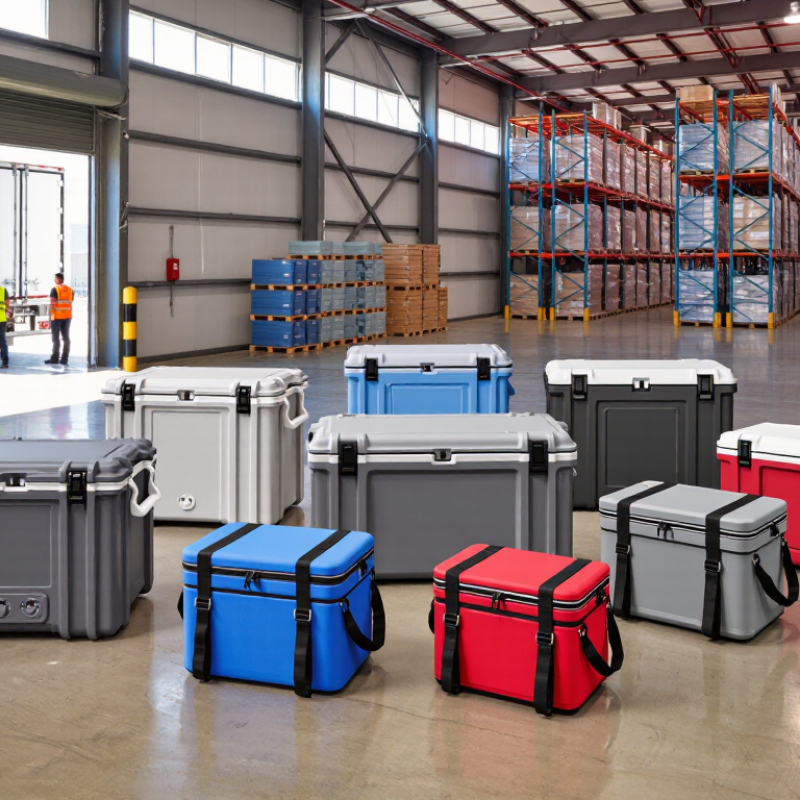
Cool Box Market Scope: Types, Capacities, and 2–8°C Use Cases
China Top 10 Cool Box Manufacturers for Global Buyers
Cool box selection starts with temperature, not appearance. The World Health Organization identifies 2–8°C as a common storage range for many temperature-sensitive medical products. MarketsandMarkets valued the global cold chain equipment market at about USD 33 billion in 2024. It projects continued growth through 2029.
Three types dominate practical procurement.
Passive boxes use insulation and phase-change packs. They suit short deliveries without electricity.
Active boxes use compressors or thermoelectric systems. They support repeated transport and longer holding times.
Hybrid units offer flexibility, but their controls need careful testing. Small 5–15 liter boxes fit field sampling. Medium 20–40 liter models support clinics and laboratories. Larger 50–100 liter units serve regional distribution.
Capacity can mislead.
Rated volume is not usable volume. Packaging, coolant packs, and air gaps reduce the payload. Field checks should measure the internal space with real containers. WHO’s vaccine management guidance also stresses temperature monitoring, conditioning procedures, and documented handling.
Ask manufacturers for mapping reports, holdover tests, alarm records, and calibration certificates. A box that reaches 2°C quickly may still create freezing risks near the coolant pack. That detail is often overlooked. It should not be.
Shipping conditions also matter, including ambient heat, opening frequency, and vehicle time. No single capacity fits every 2–8°C use case, and supplier claims deserve independent verification.
Ranking Criteria for China’s Top 10: MOQ, Output, Export Reach, and 24–72-Hour Retention
China Top 10 Cool Box Manufacturers for Global Buyers
A practical ranking should begin with MOQ, not glossy catalogs. For small retailers, 100–500 units may be workable. Large distributors often require 5,000 units or more. Factory output matters too. Request monthly capacity, shift records, and recent production photos. A supplier claiming 100,000 units monthly should show mold numbers, assembly lines, and inspection logs.
Export reach needs measurable evidence. The World Bank’s 2023 Logistics Performance Index placed China 19th globally, with a 3.7 score. This supports strong logistics capability, but it does not prove every factory ships reliably. Check destination-country records, loading ports, customs documents, and repeat-order history. International Trade Centre Trade Map data also places China among major exporters of plastic transport products under HS 3923. Classification can include multiple products, so treat it as directional evidence.
Retention testing separates useful cool boxes from attractive samples. Ask for independent test results covering 24, 48, and 72 hours. ASTM D3103 provides a recognized approach for evaluating insulated shipping containers, although real results change with ice quantity, ambient temperature, and opening frequency. Tips: Compare identical test conditions. Record core temperature, not surface temperature. One weak point remains: factory claims are often clearer than their test methods. Require batch-level inspection before payment.
Insulation Comparison: EPS, PU, and EPP by R-Value, U-Value, and Density
For global buyers comparing China’s cool box manufacturers, insulation data deserves more attention than catalog photos. The U.S. Department of Energy commonly assigns EPS about R-3.6 to R-4.2 per inch. PU often reaches R-5.8 to R-7.0 per inch. EPP usually delivers about R-3.5 to R-4.5 per inch, depending on bead structure and density. Higher R-value means stronger resistance to heat flow.
At 30 mm thickness, typical thermal conductivity values create different results. EPS at 0.035 W/m·K gives a material R-value near 0.86 m²K/W. PU at 0.022 W/m·K reaches about 1.36. EPP at 0.038 W/m·K provides roughly 0.79. The matching U-values are approximately 1.16, 0.74, and 1.27 W/m²K. These figures follow ISO 8301 heat-flow testing principles, but they exclude lids, seams, handles, and thermal bridges. Real boxes perform differently. That detail is easy to miss.
Tips: Ask for tested wall conductivity, density, and full-box heat-retention results. EPS commonly weighs 15–30 kg/m³, while PU is often 35–45 kg/m³. EPP may range from 30–80 kg/m³, trading weight against impact resistance. ASTM C518 or ISO 8301 reports are useful, yet test temperature and specimen conditioning matter. A thinner PU wall may outperform thicker EPS, but poor sealing can erase that advantage. I would not choose by R-value alone. Geometry still decides much of the outcome.
China’s Top 10 Cool Box Manufacturers: Products, Certifications, and Production Strengths
China Top 10 Cool Box Manufacturers: Products, Certifications, and Production Strengths
China’s leading ten cool box manufacturers serve outdoor, retail, catering, and transport applications. Their portfolios usually include hard coolers, soft bags, insulated backpacks, and powered models. Grand View Research places the global coolers market above USD 2 billion, with steady growth driven by travel and outdoor recreation. However, published market estimates vary by product definition.
Production capability separates serious suppliers from trading companies. Strong factories operate injection molding, rotational molding, PU foam filling, sewing, and assembly lines. They also test insulation, leakage, hinges, handles, and load performance. Export-focused manufacturers commonly maintain ISO 9001 systems and provide REACH, RoHS, CE, FDA food-contact, or LFGB compliance documents, depending on the destination. These documents require checking. A certificate alone does not prove every model complies.
The best suppliers can provide pilot samples, material declarations, test reports, and traceable batch records. Some factories run automated molding cells and maintain annual capacities above 100,000 units. Others specialize in smaller custom orders, which may suit emerging brands better. Mordor Intelligence reports continued expansion in portable cooling demand, especially through e-commerce and recreational use. Yet factory claims about capacity can be optimistic. Buyers should verify production photos, audit records, inspection methods, and recent shipment evidence. A practical comparison should examine cooling duration, empty weight, carton efficiency, defect rates, and replacement-part support—not only the lowest quotation.
Global Buyer Due Diligence: EN 12546-2, ASTM D4169, ISO 9001, and Food-Contact Compliance
For global buyers, a cool box is more than a molded shell and foam layer. FAO reported that about 14% of food is lost between harvest and retail. Reliable insulation can reduce exposure during short transport, but only when tested under realistic conditions.
EN 12546-2 helps assess insulated bags, boxes, and cases for food-contact use. Ask manufacturers for test scope, temperature records, and material declarations. ASTM D4169 evaluates distribution hazards, including vibration, compression, and impact. A useful supplier should provide the distribution cycle used, not only a passing statement. Request pallet-level evidence. A one-meter drop photo is not enough.
ISO 9001 supports controlled production, corrective actions, and traceability. The ISO Survey 2022 recorded more than 1.2 million ISO 9001 certificates worldwide, showing its broad adoption. Yet certification does not prove thermal performance or food-contact safety. Check the certificate scope, issuing body, validity, and factory address. For food-contact materials, review migration testing against the destination market’s rules, such as EU Regulation 1935/2004 and applicable plastic requirements. Manufacturing changes can alter results. This is often missed. Keep samples from the approved batch, inspect gasket fit, and record internal temperature with calibrated data loggers. Supplier paperwork can look complete while test conditions remain unclear.