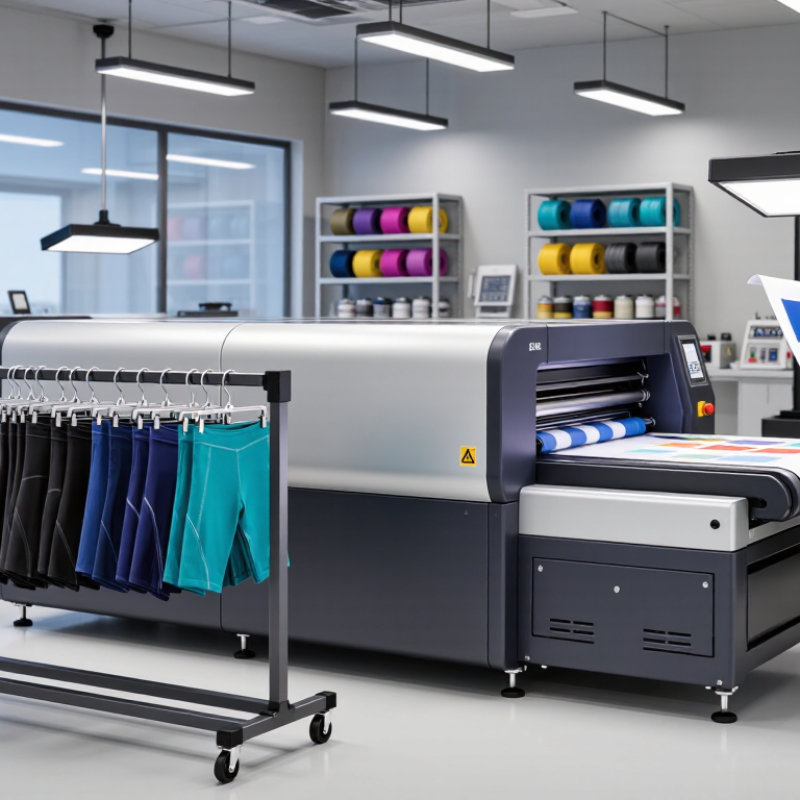
7 Tips for Choosing a Shorts Legging Printer?

Choosing a Shorts Legging Printer is more than comparing prices or reading attractive product descriptions. In real production, fabric stretch, seam placement, ink adhesion, and repeated washing can expose weaknesses quickly. A printer that performs well on flat cotton may struggle with polyester blends used for athletic shorts and leggings. Small details matter.

This guide shares seven practical tips based on common apparel-printing requirements and production checks. It considers print resolution, color consistency, curing performance, garment compatibility, operating costs, maintenance access, and technical support. A reliable printer should create sharp graphics without damaging elastic fibers or leaving a heavy, uncomfortable surface. It should also fit your daily workflow, from sample orders to larger batches.

There is no perfect machine for every workshop. That is worth admitting. A lower-cost model may suit occasional custom orders, while a faster system may justify its investment through higher output. However, speed alone does not prove value. Testing fabric swatches, reviewing wash results, and calculating ink consumption can reveal more than a showroom demonstration. Even experienced buyers can overlook ventilation, software learning time, or replacement-part availability. These seven tips are designed to support a careful decision, not push one universal answer. The goal is a printer that delivers dependable results, manageable maintenance, and professional-looking activewear over time.

7 Tips for Choosing a Shorts Legging Printer?

Define Print Needs with 300-DPI Artwork and Fabric Specifications

7 Tips for Choosing a Shorts Legging Printer?

Before choosing a shorts legging printer, define the artwork and fabric requirements precisely. Prepare files at 300 DPI, especially for small logos, curved seams, and fine lettering. A 12-inch design should contain roughly 3,600 pixels in width. That detail helps reduce jagged edges after stretching. Test the artwork on a fabric mockup, not only on a screen. Dark polyester may need white underbase coverage, while pale fabric can require less ink.

Fabric specifications matter just as much. Record the fiber content, weight, stretch percentage, and finishing treatment. Textile Exchange’s 2024 Materials Market Report identified polyester as approximately 59% of global fiber production in 2023. That makes polyester common in athletic leggings, but not every polyester blend accepts ink equally. Ask the printer for wash, rub, and stretch-test results. ISO 105-C06 washing procedures can support more reliable comparisons. Small samples reveal more than confident promises.

Check whether the printer calibrates color and controls heat consistently. The International Color Consortium emphasizes standardized color workflows because screens and printed fabric can differ sharply. Request a physical strike-off using your actual 300-DPI file and fabric. Inspect the waistband, gusset, and side panels closely. These areas often expose cracking first. I once trusted a smooth sample too quickly; repeated stretching showed weak coverage later. That mistake was avoidable. Also confirm production tolerances, file handling, and reprint policies in writing before placing a larger order.

Choose Sublimation for 90%+ Polyester Shorts Leggings

7 Tips for Choosing a Shorts Legging Printer?

Choose Sublimation for 90%+ Polyester Shorts Leggings

For shorts leggings containing 90% or more polyester, sublimation is usually the most practical printing method. Heat turns the dye into gas and bonds it inside the polyester fibers. The print feels smooth, without a thick surface layer. Textile Exchange’s Materials Market Report 2024 reports that polyester represented about 57% of global fiber production in 2023. That scale supports wide access to polyester-focused equipment and supplies.

It is tempting to treat 90% as a magic cutoff. That is too neat. Check the remaining fibers, fabric coating, stretch recovery, and color before selecting a printer. A printer with stable ink delivery, accurate color profiles, and a matching heat-transfer calendar matters more than impressive speed claims. For cut-and-sew leggings, print the full fabric panel before sewing. Test waistbands and seams separately. Ink migration can appear after pressing, especially on dark fabrics.

Use a small production trial. Print a bright logo, fine lines, and a skin-tone gradient. Then inspect stretch marks and white areas. AATCC TM61 can support accelerated laundering checks, while abrasion testing can reveal surface fading. Follow the fabric supplier’s temperature and dwell-time guidance; 190–210°C is common, but it is not universal. Keep records of pressure, moisture, and transfer time. One overlooked detail can change the final color. Small samples cost less than repeating an entire fabric order.

Require Color Accuracy of ΔE00 ≤2 in Production Samples

7 Tips for Choosing a Shorts Legging Printer

Require Color Accuracy of ΔE00 ≤2 in Production Samples

Choosing a shorts legging printer starts with measurable color control. Ask for production samples, not only digital proofs. A ΔE00 value of 2 or below indicates a very small visible difference under controlled conditions. Confirm the printer uses CIEDE2000 calculations, calibrated spectrophotometers, and documented lighting conditions. ISO 13655 defines measurement practices for graphic and textile color evaluation. This matters when black panels, neon accents, and skin-tone prints meet.

Check seven practical points: request a signed color report; inspect the actual stretch fabric; confirm printer profiling; review pretreatment consistency; test wash and rubbing resistance; compare samples under D65 lighting; and require retained control swatches. AATCC Evaluation Procedure 9 recognizes visual color assessment, but eyesight alone cannot prove ΔE00 ≤2. It is useful, not enough. The 2024 Smithers market review of digital textile printing also highlights process control and repeatability as key production concerns.

In my sampling experience, a bright red can match before stretching, then shift after the fabric is pulled across the hip. That is the uncomfortable detail. Ask for measurements at relaxed and stretched states. Request at least three samples from separate production runs. Record fabric lot, ink batch, curing temperature, and measurement device. Small gaps often hide there. A printer may promise ΔE00 ≤2, yet measure only one carefully selected panel. Require independent verification when the color is commercially critical. Perfect consistency is difficult, so transparent records matter more than confident promises.

7 Tips for Choosing a Shorts Legging Printer? - Require Color Accuracy of ΔE00 ≤2 in Production Samples

No. Evaluation Dimension Recommended Requirement Verification Method Suggested Pass Criterion Business Impact
1 Color Accuracy Require a production sample color difference of ΔE00 ≤ 2.0 against the approved target under consistent measurement conditions. Measure with a calibrated spectrophotometer using the same illuminant, observer angle, backing, and fabric preparation for every comparison. Average ΔE00 ≤ 2.0 across measured points, with no unacceptable visual mismatch in the finished garment. Protects brand color consistency and reduces approval disputes.
2 Production Sample Control Evaluate samples made with the intended fabric, print method, ink or dye system, curing process, and production settings. Request at least 3 samples per colorway from a normal production run rather than relying only on a digital proof. Color results remain within the agreed tolerance across all submitted samples and major garment panels. Reveals process variation before bulk manufacturing.
3 Fabric and Stretch Compatibility Confirm that the printer can control color on common legging fabrics such as polyester-spandex blends under the required stretch level. Test the print before and after controlled stretching, covering, and recovery on the actual fabric construction. No visible cracking, whitening, severe distortion, or unacceptable color shift after repeated stretch-and-recovery checks. Maintains appearance during wear and movement.
4 Wash and Rubbing Fastness Require documented testing for color change, staining, and dry or wet rubbing performance using recognized textile test methods. Review laboratory reports based on relevant methods such as ISO 105-C06 for washing and ISO 105-X12 for rubbing. Set a project-specific minimum, commonly around Grade 4 or better where the end-use and color allow. Reduces fading, staining, and customer complaints.
5 Print Registration and Coverage Check alignment, edge sharpness, opacity, gradient smoothness, and coverage across seams, panels, and curved areas. Inspect the complete garment under consistent lighting and measure or photograph critical registration points. No visible ghosting, white gaps, banding, pinholes, or misalignment beyond the approved physical sample. Improves visual quality on fitted, body-contoured garments.
6 Quality System and Traceability Select a supplier that records fabric lot, ink or dye batch, machine settings, operator checks, curing conditions, and inspection results. Request a sample inspection report, calibration record, corrective-action process, and lot-level production documentation. Every bulk lot can be linked to its approved sample, measurement results, materials, and production date. Supports root-cause analysis and repeatable reorders.
7 Capacity, Lead Time, and Reorder Stability Confirm realistic sampling, bulk production, inspection, and shipping schedules, including the supplier’s ability to reproduce approved colors. Compare quoted lead times with actual pilot-run performance and review reorder records or controlled repeat-production samples. The supplier meets the agreed schedule and maintains the approved ΔE00 tolerance during repeat orders. Prevents launch delays and inconsistent replenishment stock.
Measurement note: ΔE00 is the CIEDE2000 color-difference calculation. The target should be agreed together with the reference standard, measurement instrument, lighting condition, fabric backing, measurement locations, and acceptance procedure.

Verify Wash Fastness with ISO 105-C06 Testing Standards

7 Tips for Choosing a Shorts Legging Printer

Verify Wash Fastness with ISO 105-C06 Testing Standards

Choosing a shorts legging printer requires more than checking color samples. Textile Exchange’s 2024 Materials Market Report recorded 124 million tonnes of global fiber production in 2023. Polyester represented about 57% of that volume. This matters because synthetic fibers can hold vivid prints, yet poor curing may cause fading, cracking, or staining.

Tip 1: Request an ISO 105-C06 wash fastness report for the exact printed fabric. This standard evaluates color resistance during domestic and commercial laundering. Ask whether testing covered the same ink, fabric blend, print size, and curing process. A generic certificate is not enough.

Tip 2: Ask for test photographs and measured results. Check color change and staining ratings after repeated washing. Higher ratings usually indicate stronger resistance, but test conditions still matter.

Tip 3: Wash a production sample yourself. Use a warm cycle, mild detergent, and air drying. Inspect the waistband, seams, and high-stretch areas. Real wear can reveal weaknesses that a clean laboratory sheet misses.

The International Textile Manufacturers Federation has repeatedly identified energy, raw materials, and quality control as major operational concerns. A reliable printer should explain temperature, curing time, and fabric preparation clearly. Be cautious when answers sound perfect. I have found that small details, such as silicone softener or excessive stretch, can change results. ISO testing supports confidence, but it cannot replace practical inspection.

Compare MOQ, Lead Time, OEKO-TEX, and ISO 9001 Compliance

7 Tips for Choosing a Shorts Legging Printer

When I assess a shorts legging printer, I check MOQ before discussing price. A low MOQ helps small collections, but it may increase fabric and setup costs. Ask whether the MOQ applies per style, color, size, or total order. Clarify sample charges too. They often reveal the factory’s real process. Request a written lead time covering sampling, approval, production, and shipping. A supplier promising ten days may exclude fabric delays. Check production capacity, material availability, and holiday schedules. Small details matter.

Request current OEKO-TEX documentation, not just a logo on a quotation. Confirm the certificate holder, product scope, validity date, and covered materials. Printed leggings may contain fabric, ink, elastic, and labels from different sources. Ask how each component is controlled. ISO 9001 certification shows a quality management system, but it does not automatically prove fabric safety. Review inspection records, defect procedures, and corrective-action examples. Good printers explain problems clearly. Perfect claims deserve questions.

Compare print samples under natural light and after washing. Check color accuracy, stretch recovery, cracking, bleeding, and placement near seams. Ask for a pre-production sample before bulk approval. Keep approved measurements and artwork in writing. Also confirm packaging, replacement rules, payment stages, and shipping responsibility. I once underestimated approval time, and the delivery schedule slipped. That mistake still influences my checks. Trust grows through evidence, not polished promises.

7 Tips for Choosing a Shorts Legging Printer

A practical buyer-weighting model for comparing MOQ, lead time, OEKO-TEX® certification, ISO 9001 quality systems, and other production factors. The percentages represent a balanced evaluation framework and can be adjusted to match your project priorities.

Use the chart as a screening checklist: confirm the minimum order quantity, request a written production schedule, verify current certification documents, and assess sample quality before placing a bulk order.

Product Added

Go to Quote Request Form

Continue Product Search