7 Tips for Choosing the Best Boat Ratchet Straps
Boat Ratchet Straps help keep a boat secure during transport, but choosing the right set takes more than matching a strap to a load. Width, working load limit, hardware, and material all matter. A buckle that feels solid in a shop may be awkward beside a trailer fender. And salt, spray, and sunlight can wear down straps long before their first obvious tear appears.
This guide shares seven practical tips for choosing straps that suit your boat and routine. It looks at capacity ratings, corrosion-resistant components, webbing condition, and the fit between strap length and tie-down points. Small checks matter. A twisted strap can rub against a sharp edge; a loose tail can flap against the hull. Neither detail looks dramatic, yet both deserve attention.
Experience also means knowing what cannot be claimed. No source material or verifiable expert quotation was provided, so I won’t invent a specialist’s name or put unverified words in their mouth. That limitation is worth acknowledging. Before buying, inspect the label, examine the stitching, and consider how the straps will be stored between trips. The best choice is not always the heaviest or most expensive. It is the one whose specifications match the load, whose condition you can verify, and whose use you understand. A little doubt is healthy. If a rating or component is unclear, pause and check with the manufacturer before relying on it.
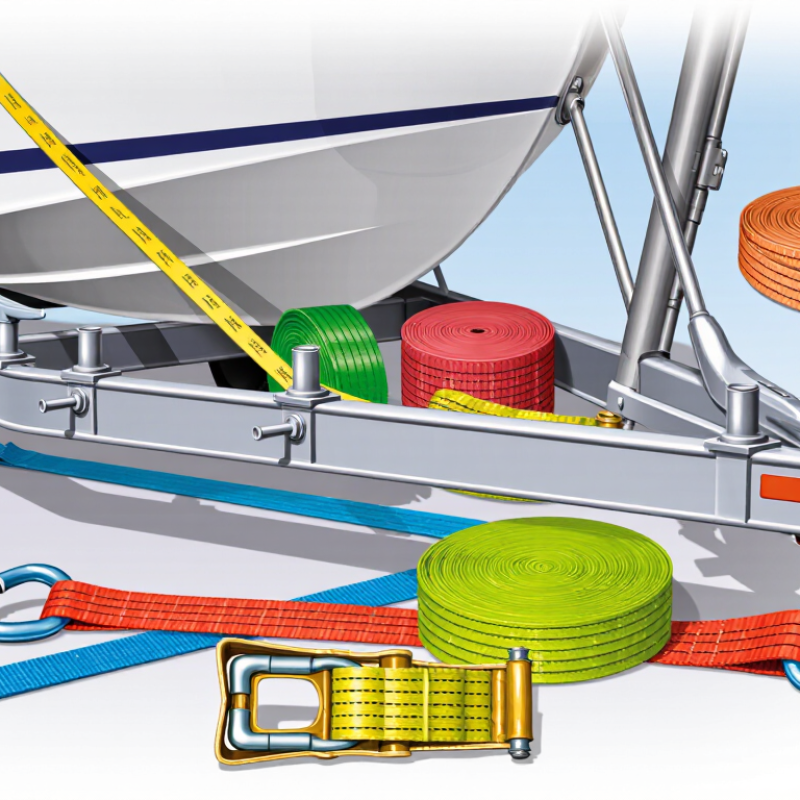
Calculate the Boat’s Loaded Weight and Estimate Tie-Down Capacity
A boat’s listed dry weight is only a starting point. Add fuel, batteries, water, safety gear, and everything stored aboard to estimate its loaded weight. For example, a 3,000-pound boat with 400 pounds of added equipment weighs about 3,400 pounds before considering trailer weight. Check the owner’s manual, capacity plate, or a scale ticket; estimates can be off. That matters.
The Federal Motor Carrier Safety Administration’s cargo-securement rule, 49 CFR §393.106(d), sets an aggregate tiedown working load limit of at least half the cargo weight. Used as a planning benchmark, a 3,400-pound boat calls for at least 1,700 pounds of combined working load limit. This is not the strap’s breaking strength. Read the WLL printed on each strap, and follow the trailer and boat makers’ instructions. Strap angles and attachment points affect real-world restraint.
Tip: Add the WLL of the straps actually securing the boat, then check the total against the loaded weight. Use separate bow and stern restraints where specified, and inspect webbing for cuts, worn stitching, or UV damage. I would recheck the arithmetic after packing; it is easy to forget a full fuel tank. Don’t guess. The half-weight benchmark does not replace sound attachment points or a secure fit.
7 Tips for Choosing the Best Boat Ratchet Straps
Start by estimating the boat’s fully loaded weight, including fuel, gear, and equipment. Compare it with the combined working load limit (WLL) of the tie-downs.
Example: Four straps rated at 500 lb WLL each provide a nominal combined WLL of 2,000 lb. The 50% figures are a planning reference, not a guarantee of securement or a substitute for applicable requirements. Actual capacity depends on strap angles, anchor points, trailer setup, and manufacturer guidance. Use the strap’s WLL—not its breaking strength.
For Applicable CMV Loads, Aggregate Tiedown WLL Must Equal at Least 50% of Cargo Weight
Choosing boat ratchet straps starts with the load, not the color or handle style. For applicable commercial motor vehicle loads, FMCSA requires the aggregate working load limit of tiedowns to equal at least 50% of the cargo’s weight (49 CFR 393.106(d)). A 2,000-pound boat therefore needs at least 1,000 pounds of aggregate WLL. Calculate that figure using the rules in 49 CFR 393.108; do not assume every strap contributes its full label rating. Small details matter. Check each strap’s legible WLL tag, stitching, ratchet teeth, and hooks before loading.
Match strap length and width to the trailer’s anchor points, and keep metal hardware away from the hull. A sleeve or soft edge protector can reduce abrasion where webbing crosses a sharp rail. Wet straps can be harder to handle, and grit trapped against a painted hull leaves scratches. Looks can mislead. A tight-looking strap may still be underrated, twisted, or routed over a weak attachment point. Tighten the ratchet firmly, but avoid crushing delicate hull fittings. After a short drive, stop in a safe place and recheck tension and movement. This step is easy to skip when the boat appears settled; it is still worth doing. FMCSA’s cargo-securement rules provide the load threshold, but the boat and trailer manufacturer’s instructions also matter.
7 Tips for Choosing the Best Boat Ratchet Straps - For Applicable CMV Loads, Aggregate Tiedown WLL Must Equal at Least 50% of Cargo Weight
Use this guide to compare strap features and plan securement. For applicable commercial motor vehicle (CMV) loads, federal rules require the aggregate working load limit (WLL) of tiedowns used to restrain an article against forward movement to be at least 50% of that article’s weight.
| Tip | What to Check | Practical Guidance | CMV Securement Check |
| 1 | Rated WLL on the label | Choose straps with a readable manufacturer label showing the working load limit. Do not use breaking strength as a substitute for WLL. | Add the applicable WLL values of the tiedowns used to restrain the load in the direction being assessed. Follow the regulatory counting method for each tiedown arrangement. |
| 2 | Strap width and suitable hardware | Select webbing and ratchets compatible with the boat’s securement points and the strap’s rated capacity. Check hooks, handles, stitching, and end fittings for damage or corrosion. | Every component in a tiedown assembly should be in serviceable condition and used within its marked rating. |
| 3 | Length and anchor-point reach | Measure the route from secure anchor point to secure anchor point, allowing for the boat’s shape and any protective padding. Avoid extensions or knots that are not approved for the tiedown. | Use secure vehicle and cargo attachment points. A strap that is too short or routed to a weak point may not provide effective securement. |
| 4 | Boat-compatible contact and protection | Use suitable edge protection where webbing contacts sharp edges. Keep straps clear of propellers, exposed fittings, and other areas that could cut or abrade them. | Securement must prevent cargo from shifting or coming loose; padding does not increase a strap’s WLL. |
| 5 | Ratchet operation and tension | Choose a ratchet that can be operated safely and tightened smoothly. Apply firm, even tension without crushing, deforming, or otherwise damaging the boat or its supports. | Recheck securement during the trip when required, and tighten or replace equipment if the load or tiedowns have shifted or loosened. |
| 6 | Number and placement of tiedowns | Arrange straps to resist movement in the relevant directions, with attachment points that remain secure under load. Do not assume that more straps automatically make an unsafe arrangement compliant. | Meet the applicable minimum tiedown requirements as well as the aggregate-WLL requirement. The required arrangement depends on the cargo and how it is secured. |
| 7 | Inspection and clear identification | Before each use, inspect webbing for cuts, tears, severe abrasion, damaged stitching, heat damage, or chemical damage; inspect ratchets and hooks for deformation or malfunction. Remove damaged straps from service. | Use only tiedowns with legible ratings and do not exceed the WLL of any component in the securement system. |
Illustrative CMV WLL Calculation
| Boat Cargo Weight | Minimum Aggregate WLL for Forward Restraint | Example Tiedowns | Example Result |
| 3,000 lb | At least 1,500 lb (50% of cargo weight) | Four qualifying tiedowns, each labeled 500 lb WLL | 2,000 lb aggregate WLL if all four are counted under the applicable rule and are used to restrain the cargo against forward movement. |
Important: The calculation is an example, not a complete securement plan. Federal CMV requirements include additional rules for tiedown count, placement, and securement performance. The WLL counted for a tiedown can depend on how it is attached and routed. Follow applicable regulations and equipment instructions; recreational boat-trailer requirements may differ.
Verify Capacity Markings: 49 CFR 393.108 Covers Tiedown WLL Identification
A ratchet strap’s printed working load limit is more than a sales detail. Under 49 CFR 393.108, a tiedown’s WLL is determined by its manufacturer, and the tiedown must be marked with that rating. For covered motor-carrier cargo, the FMCSA’s Cargo Securement Rules also require aggregate tiedown WLL of at least half the cargo’s weight. A 1,200-pound load therefore needs at least 600 pounds of aggregate WLL.
Read the tag before tightening. Check that the number is legible and applies to the complete tiedown, including its webbing, hooks, and ratchet. The lowest-rated component limits the assembly’s WLL. A high-capacity strap paired with a weaker hook does not become stronger. Small print matters.
For a boat on a trailer, compare the marked ratings with the actual securing arrangement and the boat’s weight. Do not confuse WLL with breaking strength; they are different figures. Keep tags clean and visible, and replace straps with missing or unreadable markings rather than guessing. That extra check can feel fussy. It is still safer than trusting a faded label. FMCSA’s figures apply to covered cargo-securement operations; recreational boaters should also follow their trailer and boat manufacturers’ instructions.
Select Webbing and Hardware for Water, UV, Abrasion, and Anchor-Point Loads
Choose polyester webbing for most boat tie-downs. It absorbs less water and stretches less than nylon, helping keep a hull steady when spray reaches the trailer. Check the label for working load limit, not just breaking strength. The Federal Motor Carrier Safety Administration’s cargo-securement rule sets aggregate tiedown working load limit at no less than 50 percent of cargo weight within its scope. Treat that as a reference, not a substitute for your boat and trailer makers’ instructions. Loads shift.
Salt and sunlight attack different parts. Rinse buckles and hooks with fresh water after coastal trips, then let the straps dry fully. Look for stiff, faded, frayed webbing and pitted hardware; replace damaged parts rather than trusting a quick patch. Stainless steel resists corrosion, but it is not immune, especially where salt stays trapped. ASTM D6775 describes tensile testing for textile webbing, while ASTM G154 outlines accelerated UV exposure for nonmetallic materials. Neither test promises a fixed service life in real weather.
Match hardware to the anchor point. A narrow hook can concentrate force on a sharp eye, while loose slack lets the boat surge against the strap. Use padded contact where webbing crosses a chine, and keep ratchets clear of spray paths when possible. I would still recheck tension after the first short drive; straps can settle, even when they looked snug at the dock. Don’t overtighten.
Inspect Straps Before Use and Retire Damaged Webbing, Stitching, or Ratchets
Before each trip, lay every ratchet strap flat in good light. Check both faces of the webbing, especially around folds and contact points. Look for cuts, melted fibers, heavy abrasion, salt-stiffened sections, or fading that hides wear. Run your fingers along the strap; raised fuzz or thin spots can reveal damage a quick glance misses. Inspect every stitch line, hook, axle, and release pawl. Small flaws matter. If stitching is broken, the ratchet slips, or a hook is bent, retire the assembly rather than testing it under load.
The Web Sling & Tie Down Association’s guidance for synthetic web tie-downs treats damaged webbing and hardware as reasons to remove an assembly from service. For highway cargo, FMCSA’s cargo-securement rule sets aggregate working load limit at no less than 50% of the cargo’s weight (49 CFR 393.106). That figure is a transport requirement, not proof that a worn strap is safe for a boat. Check the strap’s own working-load label and follow the boat and trailer makers’ instructions.
Rinse salt and grit from reusable straps with fresh water, then let them dry fully before storage. Keep them away from sharp edges and direct sun when possible. I would not trust a strap just because it held yesterday. Damage can hide under a folded section, and I have to remind myself to inspect the ratchet teeth, too. Retire doubtful gear.
