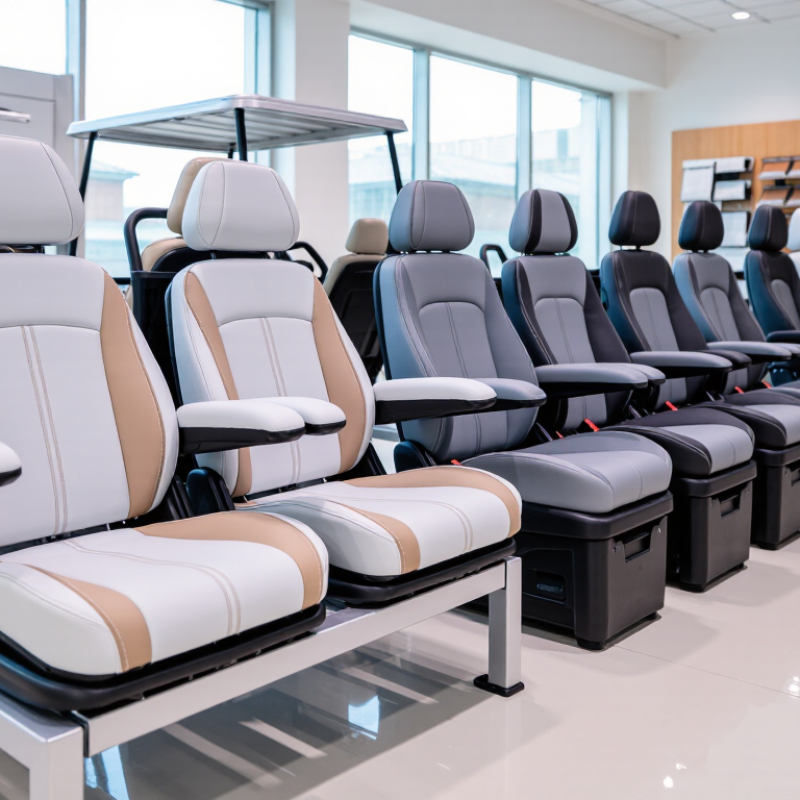
China Top Golf Cart Seat Manufacturers and Suppliers

China Top Golf Cart Seat Manufacturers and Suppliers are attracting attention from distributors, fleet operators, resorts, and vehicle upgrade specialists. The country offers broad production capacity, competitive pricing, and flexible customization. Buyers can request replacement cushions, complete rear seats, flip-flop assemblies, and tailored upholstery colors. Material selection remains critical. Marine-grade vinyl, closed-cell foam, stainless-steel fasteners, and reinforced stitching can improve performance in humid outdoor environments.

Michael Lee, an independent golf-cart seating consultant, states, “A seat is not just padding; it is the driver’s daily contact point with the vehicle.” That practical view matters. A well-designed Golf Cart Seat should support posture, resist ultraviolet exposure, and remain comfortable after repeated use. Suppliers should explain foam density, frame construction, seam treatment, mounting compatibility, and cleaning requirements. Clear technical drawings also reduce fitting problems during installation.

Reliable manufacturers usually provide samples, factory photographs, inspection records, and stable communication. They should answer specific questions about golf-cart brands, production lead times, packaging, replacement parts, and quality checks. A factory may look impressive online, yet its stitching or foam consistency can still disappoint. That risk deserves attention. Buyers should test one sample before placing a large order.

Some comparisons may remain imperfect because suppliers use different testing methods. That limitation should be acknowledged, not hidden. The strongest sourcing decision balances comfort, durability, appearance, after-sales support, and total landed cost. For international buyers, careful verification creates a safer purchasing process and a more dependable long-term supply relationship.

China Top Golf Cart Seat Manufacturers and Suppliers

Golf Cart Seat Manufacturing in China: An Industry Overview

China’s golf cart seat manufacturing sector is expanding with wider vehicle demand. Grand View Research estimated the global golf cart market at about USD 1.9 billion in 2023, with a projected 6.5% annual growth rate through 2030. These figures do not isolate seats, but they show a growing component opportunity for Chinese manufacturers and suppliers.

Production usually combines molded foam, plywood or composite bases, synthetic leather, stitching, and metal fasteners. Factory teams check foam density, seam alignment, mounting-hole accuracy, and surface tension.

A seat may look acceptable on a sample table, yet fail after heat, moisture, and repeated loading. That gap matters. Many Chinese facilities now use digital cutting equipment and standardized inspection records, improving consistency across export orders.

The market is capable, but not flawless. IMARC’s industry research also identifies rising demand for electric mobility and customized interiors. Custom colors, thicker cushions, rear flip seats, and weather-resistant covers are common requests. However, buyers should verify compression recovery, ultraviolet resistance, and hardware corrosion protection. Some suppliers provide attractive samples but limited traceability. A practical audit should review incoming-material records, production photos, test reports, and random finished-seat inspections. Small details matter here. A loose bracket or uneven stitch can become a costly complaint after installation.

Types of Golf Cart Seats and Their Key Features

Golf cart seats vary by purpose, climate, and passenger movement. Standard bench seats offer simple support for daily course use. Bucket seats provide deeper side bolsters and better control on uneven paths. Flip-flop seats add a rear-facing platform for passengers or light cargo. They save space.

Grand View Research projects steady growth in the global golf cart market through 2030. MarketsandMarkets also identifies rising use in resorts, campuses, and gated communities. These reports do not measure seat sales directly, but they indicate growing demand for durable seating systems. Practical inspection supports this trend. High-density foam keeps its shape longer. Marine-grade vinyl resists moisture, stains, and repeated cleaning. Textured surfaces improve grip, especially after rain. UV-resistant covers reduce cracking under strong sunlight.

Fit matters.

The seat base should match the cart frame precisely. Poor alignment can create movement, noise, or uneven pressure. Suspension seats may improve comfort on rough ground, but they require careful mounting and regular inspection. I would not choose softness alone. A very soft cushion can feel comfortable briefly, then lose support during long rides. Reports also vary in market size and forecasts, so buyers should verify local conditions before ordering.

Tips: Check foam density, stitching, hinge strength, and mounting hardware. Sit on the seat for several minutes. Test it with work clothing. Inspect drainage after washing. A seat that looks attractive may still fail in daily weather.

How to Evaluate Chinese Golf Cart Seat Manufacturers

Evaluating Chinese golf cart seat manufacturers requires more than comparing catalog prices. Grand View Research estimates the global golf cart market will expand steadily through 2030, increasing pressure on seating suppliers to improve durability and comfort. Ask for material specifications, not vague claims. Confirm foam density, vinyl thickness, UV resistance, stitching strength, and dimensional tolerance. A seat should fit the frame without forcing the mounting holes.

Request samples from the same production batch. Inspect them after heat exposure, water contact, and repeated loading. The ANSI/ITSDF B56.8 safety standard provides useful guidance for golf-car construction and operator protection. It does not replace your own seat testing. That distinction matters. A factory audit should review incoming-material records, sewing-line checks, final inspection, and product traceability. Request recent inspection reports and corrective-action records.

Look for measurable quality controls. A 1–2 millimeter mismatch can create installation problems. Check whether the supplier uses calibrated gauges and documented acceptance limits. The International Organization for Standardization reports that ISO 9001 focuses on consistent processes and continual improvement, not automatic product quality. Certification alone proves little. Visit the facility when possible, or use an independent inspection company. A perfect sample can mislead. Small defects often appear during mass production. Delivery history, packaging tests, replacement procedures, and communication speed deserve equal attention. Do not select the lowest quotation without calculating failure costs.

How to Evaluate Chinese Golf Cart Seat Manufacturers

This 100-point evaluation model prioritizes product quality and long-term durability, followed by compatibility, safety compliance, customization capability, and delivery performance. Buyers can adjust the weighting according to their vehicle type, climate, order volume, and replacement requirements.

Quality Standards and Production Processes for Golf Cart Seats

China’s golf cart seat suppliers are facing higher expectations as vehicle use expands beyond private courses. Grand View Research estimated the global golf cart market at about USD 1.6 billion in 2023, with continued growth expected through 2030. This demand makes seat consistency important, not optional. Buyers should request documented material specifications, inspection records, and traceable production batches.

A reliable seat begins with controlled foam density and stable recovery after compression. Fabric or vinyl should be checked for abrasion, ultraviolet exposure, moisture, and temperature changes. Stitching needs even spacing, reinforced corners, and clean thread tension. Production lines commonly use incoming-material inspection, cutting templates, molded-foam checks, cover fitting, and final dimensional testing. ISO 9001 certification data recorded more than 1.2 million certificates worldwide in 2022, showing how widely documented quality systems are used. Certification alone is not proof of performance.

Practical testing matters more. Samples can undergo repeated loading, humidity exposure, seam-pull testing, and surface cleaning cycles. Salt spray testing is useful for coastal applications, though it cannot represent every real environment. A strong supplier should retain batch numbers and test results. Small details matter.

Some factories still rely too heavily on visual inspection. That is a weakness. A seat may look excellent while its foam collapses early or its cover shrinks after heat exposure. Buyers should compare pre-production samples with mass-produced units and review failed-test records honestly. Perfection is unlikely, but measurable control is achievable.

How to Select and Source a Reliable Chinese Supplier

China Top Golf Cart Seat Manufacturers and Suppliers: How to Select and Source a Reliable Chinese Supplier

China’s golf cart seat industry serves vehicle makers, dealers, and replacement-part distributors worldwide. Grand View Research reports that the global golf cart market is expanding at roughly 6% annually through 2030. This growth increases demand for durable, comfortable seating. However, a polished website does not prove manufacturing capability.

Ask suppliers for material specifications, production photos, inspection records, and recent export references. Check foam density, vinyl thickness, stitching strength, UV resistance, and drainage design. A dependable factory should explain its testing process clearly. Request samples before signing a large order. Measure seat length, mounting-hole positions, cushion thickness, and backrest angles with your own drawings. One overlooked millimeter can create expensive installation problems.

Tips: Compare at least three factories. Use a written checklist. Confirm whether the quoted price includes molds, packaging, and spare covers. Request a pre-shipment inspection with photographs and measurement records. ISO 9001 certification can support process control, but it cannot replace product testing. The International Organization for Standardization emphasizes documented quality systems, not guaranteed performance. That distinction matters. I have seen buyers focus too heavily on low pricing and ignore foam recovery after compression. This is a practical weakness worth challenging. A supplier should provide a corrective-action plan when a sample fails, rather than offer vague reassurance. Check lead times during peak production periods, because the shortest promise is not always the most reliable.

China Top Golf Cart Seat Manufacturers and Suppliers - How to Select and Source a Reliable Chinese Supplier
Category Evaluation Dimension Practical Benchmark or Typical Requirement Evidence to Request from the Supplier Why It Matters
Product Fit Golf cart compatibility Confirm the cart make, model, seating capacity, generation, and front or rear seat configuration before quotation. Dimensioned drawings, installation photos, CAD files, and a compatibility list without relying only on product pictures. Seat dimensions and mounting points can vary significantly between cart models and production years.
Product Fit Seat dimensions Verify seat width, depth, backrest height, cushion thickness, platform length, and mounting-hole spacing in millimetres. Approved technical drawing with dimensional tolerances and a sample measurement report. Accurate dimensions reduce installation problems and avoid modifications during assembly.
Materials Upholstery material For outdoor use, use UV-resistant marine-grade vinyl, coated fabric, or another documented weather-resistant upholstery material. Material specification sheet, thickness data, colour reference, and UV or weathering test information where applicable. Outdoor seats are exposed to sunlight, rain, dirt, cleaning chemicals, and temperature changes.
Materials Seat foam Request a documented foam type and density. A typical automotive or outdoor cushion may use approximately 28–45 kg/m³ flexible polyurethane foam, depending on comfort and load requirements. Foam density report, hardness information, compression-recovery data, and the approved sample. Foam density and resilience affect comfort, deformation, service life, and perceived product quality.
Materials Seat base and support structure Confirm whether the base is made from moulded plastic, aluminium, powder-coated steel, or another material, and verify the expected load rating. Material declaration, structural drawing, load-test method, and test results for the completed seat assembly. The base and support structure must withstand passenger loads, vibration, impact, and repeated use.
Durability UV and weather resistance Require an agreed accelerated-weathering method, such as ASTM G154 or ISO 4892-3, when long-term outdoor exposure is important. Test conditions, exposure duration, evaluation criteria, before-and-after photos, and colour or surface-change results. Unverified UV performance may lead to fading, cracking, embrittlement, or premature upholstery failure.
Durability Water resistance Specify water-resistant upholstery, sealed or protected seams where needed, and drainage provisions for cushions used outdoors. Construction drawings, seam details, water-resistance test procedure, and photographs of drainage features. Moisture retention can cause odour, mould, foam deterioration, corrosion, and customer complaints.
Durability Corrosion protection Metal components should have a suitable coating or corrosion-resistant material for the intended environment. Salt-spray testing should be specified only when relevant to the application. Coating specification, coating-thickness records, material certificates, and salt-spray test results when included in the purchase specification. Corrosion resistance is especially important for coastal areas, humid climates, and frequently washed vehicles.
Safety Mounting and retention Verify bolt size, hole spacing, bracket design, fastener grade, locking method, and resistance to loosening during vibration. Assembly drawing, fastener specification, installation instructions, and vibration or retention test records. A secure mounting system is essential for passenger safety and reliable vehicle operation.
Quality Control Pre-shipment inspection Use a written inspection checklist covering dimensions, appearance, stitching, foam condition, hardware, colour, packaging, and function. Inspection report with photographs, sampling plan, defect classification, and corrective-action records. A documented inspection process provides measurable control over repeated orders.
Quality Control Sample approval Approve a production-equivalent sample before mass production and define that the approved sample is the quality reference. Signed or digitally approved sample record, specification sheet, colour reference, and change-control procedure. Sample approval reduces disputes involving colour, stitching, dimensions, materials, and workmanship.
Compliance Material and chemical compliance Request REACH or RoHS-related documentation only when required by the destination market, product construction, or buyer specification. Supplier declaration, applicable laboratory reports, material declarations, and documentation identifying the tested product. Compliance requirements differ by market and should be confirmed before production rather than assumed.
Supplier Capability Production process Evaluate cutting, sewing, foam shaping, moulding, metal fabrication, powder coating, assembly, and final inspection capabilities. Factory audit information, process flow chart, equipment list, production photographs, and quality-control responsibilities. In-house process control can improve consistency and reduce delays caused by uncontrolled subcontracting.
Supplier Capability Quality management ISO 9001:2015 certification can be considered as supporting evidence, but it should not replace product-specific inspection and testing. Valid certificate, certification scope, issuing body, expiry date, and recent audit information. A management-system certificate indicates process structure but does not automatically guarantee seat quality.
Commercial Terms MOQ and customization Confirm minimum order quantity separately for standard seats, custom colours, custom tooling, logos, packaging, and model-specific designs. Formal quotation showing MOQ by item, tooling charges, sample fees, customization limits, and validity period. Low-volume buyers may face different costs and conditions for customized products.
Commercial Terms Lead time Obtain separate timelines for sample production, tooling, bulk production, inspection, and shipping. The lead time should begin after confirmation of payment and specifications. Production schedule, capacity statement, holiday schedule, and written definition of the lead-time start date. Clear timing assumptions improve inventory planning and reduce unexpected delivery delays.
Logistics Packaging efficiency Confirm carton dimensions, gross weight, units per carton, protective materials, pallet requirements, and container-loading plan. Packing specification, carton artwork, drop-test requirement if applicable, and packing-list template. Large seat assemblies can create high shipping costs and may be vulnerable to compression or surface damage.
Logistics Export documentation Agree on commercial invoice, packing list, bill of lading or airway bill, certificate of origin when required, and any destination-market documents. Sample export-document package and confirmation of the supplier’s nominated export entity. Correct documentation helps prevent customs delays and unexpected import charges.
After-Sales Warranty and claims handling Define warranty duration, covered defects, exclusions, claim evidence, response time, replacement policy, and responsibility for freight. Written warranty terms, claim form, corrective-action process, and replacement or credit procedure. Clear claim rules protect the buyer when defects occur after delivery.
Supplier Selection Supplier scoring method Use a weighted scorecard: Product fit: 25% Quality: 25% Durability: 20% Commercial terms: 15% Logistics: 10% Service: 5% Completed scorecard supported by samples, documents, inspection results, quotations, and communication records. A weighted evaluation prevents the lowest price from becoming the only supplier-selection criterion.

Product Added

Go to Quote Request Form

Continue Product Search