What Is a Heavy Duty Truck and What Types Are Available?
A Heavy Duty Truck is built for work that would overwhelm an ordinary pickup. It may haul freight across highways, carry concrete through city streets, or move heavy equipment to a remote site. Its size is only part of the story. Frame strength, axle capacity, engine output, braking, and duty cycle all shape what it can safely do. A truck that looks powerful in a showroom may still be the wrong tool for a specific route.
Mike Roeth, executive director of the North American Council for Freight Efficiency, studies how trucks perform in real fleet operations. A concise paraphrase of the practical principle reflected in his work is: “A truck’s efficiency must be proven in its actual duty cycle.” That matters. A long-haul tractor spends hours at highway speed, while a refuse truck stops repeatedly and works through crowded streets. Their needs differ. So do their maintenance schedules and fuel demands.
This guide explains the main heavy-duty truck classes and the jobs they handle. It also explores common configurations, from day cabs and sleeper tractors to dump, vocational, and specialized work trucks. You will see why gross vehicle weight ratings, payload, and towing capacity matter when comparing models. Numbers help, but they do not tell the whole story. Real routes, weather, load patterns, and service access matter too. Buyers sometimes focus on engine power first. That can be a mistake. Choosing well takes a clear view of the work—and an honest look at what the truck cannot do.
How U.S. GVWR Classes 7–8 Define Heavy-Duty Trucks (26,001+ lb)
U.S. heavy-duty trucks fall mainly into GVWR Classes 7 and 8. NHTSA’s vehicle classification data place Class 7 at 26,001–33,000 pounds and Class 8 above 33,000 pounds. GVWR means the truck’s maximum rated weight when loaded, including cargo, fuel, passengers, and the vehicle itself. It is not the truck’s empty weight. That distinction matters: a tractor may look enormous, yet its class depends on its rated capacity, not its appearance.
Class 7 trucks often handle regional delivery, utility work, and construction jobs. Picture a loaded dump truck moving gravel across town. Class 8 trucks commonly include highway tractors, heavy vocational trucks, and large refuse vehicles. The Federal Highway Administration tracks truck activity by weight and vehicle type in its Highway Statistics series, while NHTSA’s classifications provide the weight-class framework. These sources help explain why “heavy-duty” covers several very different jobs. Still, a class label alone says little about payload, axle setup, or operating costs.
Tips: Check the door-jamb certification label for GVWR, then compare it with the truck’s actual loaded weight. Don’t guess from size. A quick scale check can catch a costly mismatch.
Which Powertrain and Chassis Features Support Heavy-Duty Work?
A heavy-duty truck earns its keep through a powertrain matched to its daily load. Diesel engines are common for sustained torque, while electric or hybrid systems may suit predictable routes and frequent stops. The right choice depends on payload, terrain, duty cycle, and access to charging or fuel. Peak horsepower alone tells little. Gear ratios, cooling capacity, and transmission control affect pulling ability on long grades and in stop-and-go traffic. A power take-off can also run equipment such as a hydraulic lift.
The chassis must carry weight without becoming unnecessarily harsh or heavy. Frame strength, axle ratings, suspension, and wheelbase should suit the load and body configuration. Brakes need adequate capacity for the truck’s operating weight, including when fully loaded. Tire selection matters, too; uneven wear can hint at alignment or load-distribution problems. Details count. A truck that looks capable in a yard may behave differently on a rough access road. No setup fits every job.
Tips: Match the truck’s rated capacity to real loads, not occasional best-case figures. Ask a qualified technician to review route conditions, braking needs, and maintenance access. Leave room for inspection—small issues can be easy to miss when schedules are tight.
How Highway Tractors and Semitrailers Move Long-Haul Freight
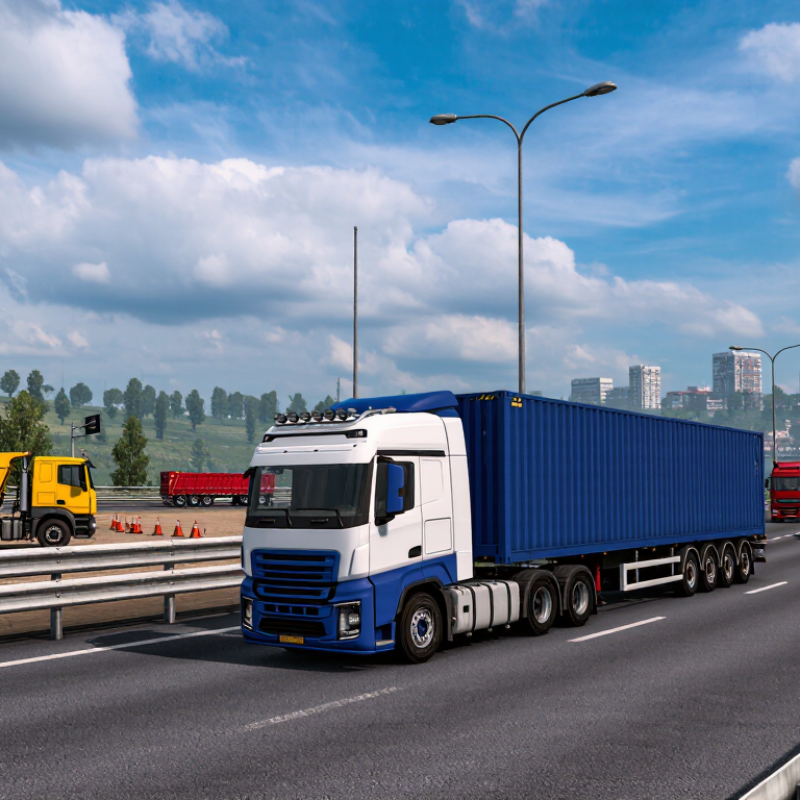
A highway tractor provides the engine, cab, and driven wheels; a semitrailer carries most of the load. The trailer’s front rests on the tractor’s fifth wheel, while its rear wheels support the other end. Together, they form an articulated vehicle that can haul large loads over long distances. A driver may check tire pressure, coupling locks, and trailer lights before departure. Small checks matter.
The scale is substantial. The American Trucking Associations’ American Trucking Trends 2023 report estimates that trucks moved 72.6% of U.S. domestic freight tonnage in 2022. For long-haul operators, tractors and semitrailers link factories, warehouses, and distribution centers across hundreds of miles. A refrigerated trailer may need steady temperature monitoring; a dry van may carry boxed goods secured behind load bars. Freight type shapes the equipment and handling.
Distance makes planning more than a route on a screen. Drivers and dispatchers account for fuel stops, weather, loading appointments, and safe rest breaks. The American Transportation Research Institute’s 2024 Operational Costs of Trucking report puts average operating costs at $2.27 per mile for 2023. That figure reflects how quickly miles add up. Yet a tidy cost estimate can miss the strain of a delayed dock or an empty return trip. Those details affect real schedules.
How Dump, Mixer, and Refuse Trucks Serve Vocational Jobs
A heavy-duty vocational truck is engineered around demanding work, not simply maximum payload. Its frame, body, and equipment must suit the job and daily route. Dump trucks carry soil, gravel, and road base, then use a hydraulic hoist to tip the bed. Uneven ground and overhead clearance matter. A larger bed is not always the better choice.
Mixer trucks transport fresh concrete in a rotating drum, which keeps the load moving until it reaches the pour. The U.S. Geological Survey estimated U.S. cement production at 91 million metric tons in 2023, reflecting the scale of material supply behind concrete work. Refuse trucks collect and compact waste through repeated stops, tight turns, and frequent loading cycles. The U.S. EPA estimated 292.4 million tons of municipal solid waste in 2018 in its Advancing Sustainable Materials Management report. That volume helps explain the demands on collection fleets. Timing matters. Each design involves trade-offs: payload, maneuverability, service access, and the route’s surface can matter more than headline capacity. A truck that fits the job on paper may still struggle in a narrow alley or on soft ground.
How the Federal 80,000-lb Interstate Limit Shapes Class 8 Configurations
A heavy-duty truck generally belongs to Class 8 when its gross vehicle weight rating exceeds 33,000 pounds. That rating describes the vehicle’s designed capacity, not the weight it may carry on every road. For interstate travel, federal rules generally set an 80,000-pound gross limit for a standard truck-and-trailer combination, subject to specific exceptions.
That total includes the tractor, trailer, fuel, driver, and cargo. A loaded five-axle combination must also meet axle-weight limits and the federal bridge formula, which accounts for axle spacing. So reaching 80,000 pounds overall does not automatically make a load compliant. Weight concentrated on one axle can exceed a limit while the full combination remains below the cap.
The limit influences common Class 8 setups: a tractor pulling a semitrailer often uses five axles to distribute weight across the combination. Operators also consider tare weight, cargo placement, and the route’s posted restrictions. An empty combination might weigh around 30,000 to 35,000 pounds, leaving less payload capacity than the headline limit suggests. The margin is tight. Actual permitted weights can vary by route, vehicle configuration, and applicable exceptions, so scale readings and current route rules matter.
