
2026 Top Traffic Calming Solutions for Global Buyers
As cities prepare for 2026, traffic calming solutions are becoming essential to safer, more comfortable streets. The World Health Organization’s Global Status Report on Road Safety 2023 estimates 1.19 million annual road deaths worldwide. Vulnerable road users remain heavily exposed, especially pedestrians, cyclists, and motorcyclists. Speed changes everything.
For global buyers, the right solution must match local traffic patterns, climate, drainage, road materials, and maintenance capacity. A raised crossing may protect children near a school, while modular traffic islands can guide vehicles around a busy market entrance. The Federal Highway Administration’s Traffic Calming ePrimer explains that speed humps, raised intersections, chicanes, and curb extensions can reduce vehicle speeds when properly designed. However, performance varies by road width, spacing, signage, and driver behavior.
The International Transport Forum’s road safety research also supports safer speed management as a core part of Vision Zero strategies. Yet, a product alone cannot solve unsafe street design. Context matters. This guide reviews leading traffic calming solutions for municipalities, contractors, distributors, and infrastructure buyers planning projects in 2026. It considers measurable speed reduction, installation time, accessibility, emergency response, durability, and lifecycle cost. It also examines standards, testing evidence, visibility, and replacement requirements across different markets.
Some recommendations may need refinement. A solution that performs well in a dry European city may fail on a tropical road with standing water. Responsible purchasing requires field trials, local engineering review, and transparent supplier documentation. The strongest choice is not always the most advanced product. It is the one that works reliably, remains visible at night, and fits the street’s real human needs.
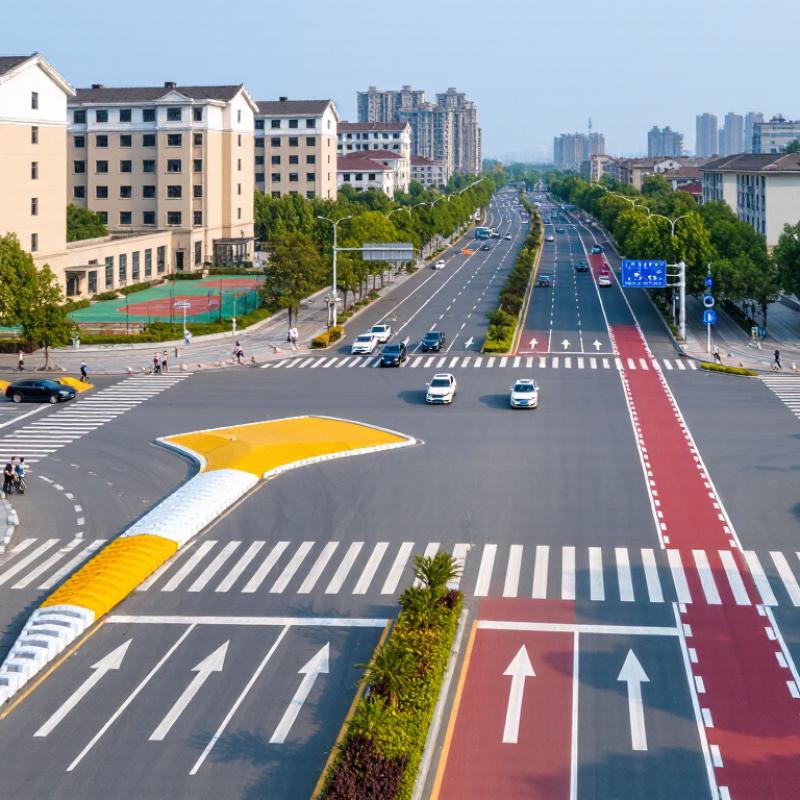
Table of Contents
[Hide]
Traffic Calming: Definition, Purpose, and Global Road Safety Needs
Traffic Calming: Definition, Purpose, and Global Road Safety Needs
Traffic calming uses physical design to reduce vehicle speed and improve street safety. Common measures include speed humps, raised crossings, curb extensions, chicanes, and traffic islands. These tools change driver behavior without relying only on warning signs or enforcement. A well-designed treatment can protect pedestrians near schools, markets, bus stops, and residential entrances.
The purpose is simple: create safer, more predictable movement for everyone. Lower speeds give drivers more reaction time and reduce crash severity. However, one solution cannot fit every city. A narrow street may need a compact raised crossing, while a wide road may require lane narrowing and clearer pedestrian space. Local engineers should study traffic volume, drainage, emergency access, weather, and road-user behavior before choosing equipment. Global buyers also need reliable materials, visible markings, safe installation, and documented performance testing. Small installation errors can create noise, water pooling, or cyclist hazards. We still underestimate these details.
Tips: Measure actual speeds before and after installation. Check visibility at night and during rain. Leave enough clearance for emergency vehicles. Consult residents, cyclists, drivers, and accessibility experts. Review the design after several months, because real traffic often exposes problems that drawings miss.
2026 Top Traffic Calming Solutions for Global Buyers
Traffic Calming: Definition, Purpose, and Global Road Safety Needs
| Traffic-Calming Solution | Definition and Primary Purpose | Typical Design Parameters | Common Operating-Speed Target | Best-Fit Road Context | Main Safety Benefits | Planning and Installation Considerations |
|---|---|---|---|---|---|---|
| Speed Hump | A raised section extending across the full roadway width to reduce vehicle speed through vertical deflection. | Commonly about 75–100 mm high with a 3.0–4.3 m long profile; exact dimensions depend on local standards and drainage needs. | Approximately 15–30 km/h | Residential streets, school zones, neighborhood access roads, and low-volume urban streets. | Reduces vehicle speeds and can lower the severity of conflicts involving pedestrians and cyclists. | Requires advance warning, visibility checks, drainage continuity, emergency-response review, and accessible pedestrian routes. |
| Speed Table | A raised platform with a longer, flatter top than a speed hump; often used to moderate speeds at crossings or intersections. | Typically about 75–100 mm high, with ramp slopes and platform length selected for the desired crossing and speed environment. | Approximately 20–30 km/h | Pedestrian crossings, school approaches, local intersections, transit-adjacent areas, and neighborhood main streets. | Encourages lower approach speeds while providing a more level pedestrian crossing than a traditional hump. | Crossing markings, tactile paving, lighting, drainage, mobility access, and bicycle comfort should be designed together. |
| Raised Intersection | An entire intersection is elevated to sidewalk or near-sidewalk level to slow turning and through movements and emphasize pedestrian priority. | Usually constructed as a raised table covering the intersection area; ramp geometry must accommodate buses, bicycles, drainage, and accessibility. | Approximately 15–25 km/h | Compact urban centers, pedestrian-priority districts, neighborhood commercial streets, and low-speed town centers. | Reduces vehicle speeds in all approach directions and shortens the perceived vertical separation between walking routes. | Needs detailed utility, drainage, loading, snow-removal, emergency-access, and junction-control coordination. |
| Curb Extension | A sidewalk or kerb area is extended into the parking lane to narrow the crossing distance and visually tighten the roadway. | Extension width is normally based on the parking lane and drainage layout; the remaining travel lane must preserve safe vehicle clearance. | Often supports approximately 20–40 km/h streets | Signalized or unsignalized crossings, urban main streets, bus-stop areas, and locations with on-street parking. | Shortens pedestrian exposure, improves visibility, and discourages high-speed cornering. | Protect sightlines, drainage inlets, bicycle movement, turning paths, accessible boarding areas, and delivery operations. |
| Chicane or Horizontal Deflection | A series of alternating lateral shifts that requires drivers to change direction and reduce speed. | Uses planted areas, kerb build-outs, parking bays, or islands; alignment must be self-enforcing without creating dangerous opposing conflicts. | Approximately 20–40 km/h | Residential streets and low-volume urban roads where adequate right-of-way exists for alternating deflection. | Reduces long, uninterrupted sight lines and limits high-speed straight-line travel. | Requires careful review of vehicle tracking, two-way passing, bicycle continuity, emergency vehicles, lighting, and maintenance. |
| Traffic Circle or Mini-Roundabout | A central island requires vehicles to deflect around the junction, replacing uncontrolled straight-through movement with lower-speed circulation. | Compact geometry is used on local streets; entry paths, central-island visibility, and truck-apron requirements vary by vehicle mix. | Approximately 20–30 km/h | Low-speed residential intersections, neighborhood centers, and locations with recurring right-angle or turning conflicts. | Reduces approach speeds and can reduce conflict severity by changing vehicle paths and limiting direct crossing movements. | Provide pedestrian crossings outside the circulating area, accessible refuge where needed, bicycle guidance, and adequate sight distance. |
| Median or Refuge Island | A raised island separates traffic directions or provides a protected waiting area for people crossing the road. | Width and length depend on pedestrian volumes, crossing distance, available right-of-way, and local accessibility requirements. | Supports safe crossings on approximately 30–50 km/h roads | Wide urban roads, bus corridors, school routes, uncontrolled crossings, and roads with substantial pedestrian activity. | Allows two-stage crossing, reduces exposure to opposing traffic, and can visually narrow the carriageway. | Use detectable edges, sufficient refuge width, clear sightlines, lighting, drainage, and emergency or maintenance access. |
| Lane Narrowing or Road Diet | Travel lanes are narrowed or reallocated to reduce the visual and operating space available for high-speed driving. | Lane widths must be selected according to speed, traffic volume, vehicle type, bicycle facilities, and local design standards. | Often suitable for approximately 30–50 km/h urban corridors | Over-wide urban roads, streets with excess capacity, corridors needing bicycle facilities, and pedestrian-oriented districts. | Can reduce operating speeds, crossing distance, and excessive lane-changing while creating space for safer modes. | Confirm capacity, transit operations, freight access, turning movements, bicycle protection, and intersection performance before implementation. |
| Filtered Permeability | Physical measures allow walking, cycling, and sometimes public transport while preventing through motor-vehicle traffic. | May use planters, bollards, modal filters, or diagonal closures; emergency access and service access must be maintained where required. | Creates low-traffic, low-speed local environments | Residential neighborhoods, school streets, active-travel networks, and areas affected by motor-vehicle rat-running. | Reduces motor traffic volumes, improves pedestrian and cyclist comfort, and limits through-traffic conflicts. | Assess traffic displacement, access for residents and deliveries, emergency response, enforcement, wayfinding, and public consultation. |
| School-Street Treatment | A time-based or permanent access-management and street-design approach that reduces motor traffic around school entrances. | May combine timed vehicle restrictions, crossings, raised tables, barriers, walking routes, and supervised access arrangements. | Typically aims for 20–30 km/h near school entrances | School frontages, child-care facilities, pedestrian-heavy campus approaches, and streets with peak-time congestion. | Reduces child exposure to moving and idling vehicles and improves visibility at arrival and departure times. | Requires clear operating hours, resident and service access plans, enforcement, safe pick-up arrangements, and continuous monitoring. |
| Rumble Strips or Rumble Markings | Raised or profiled surface treatments create noise and vibration to alert drivers to a speed-sensitive or high-risk location. | Profile, spacing, depth, and placement must follow local road standards; they should not substitute for geometric speed management. | Supports speed awareness, but results vary by site | Approaches to rural junctions, curves, crossings, work zones, and locations where driver attention is a concern. | Improves driver alertness and can reduce speed variation when combined with signs, markings, or other treatments. | Consider motorcycle safety, bicycle comfort, noise near residences, winter maintenance, accessibility, and appropriate advance placement. |
| Gateway Treatment | A visible change at the entrance to a lower-speed area that signals a transition in road function and expected driver behavior. | May combine a raised threshold, kerb build-outs, surface color or texture, signs, planting, lighting, and speed-limit markings. | Commonly marks entry to 20–40 km/h environments | Town centers, residential neighborhoods, school zones, pedestrian areas, and village approaches. | Improves recognition of a changed speed environment and can reduce entry speeds when supported by physical deflection. | Use consistent visual language, preserve sightlines, provide accessible routes, and avoid relying on appearance alone for compliance. |
Data note: Dimensions and speed ranges are commonly used planning references rather than universal requirements. Final values should be verified against the applicable national or municipal road-design, accessibility, drainage, emergency-access, and traffic-control standards. Safety outcomes depend on road context, traffic volume, design quality, compliance, and treatment combinations. Reference frameworks include international safe-system guidance and established traffic-calming manuals published by public road authorities and transport agencies.
Related Posts
-
What Are the Top Traffic Safety Products from China?
-
10 Essential Tips for Choosing the Right Pavement Marking Systems
-
2026 How to Improve Road Safety Solutions for Safer Driving
-
Top Work Zone Safety Products from China for Global Buyers?
-
What Are the 2026 Top Traffic Sign Materials?
-
How to Choose Highway Safety Systems for Your Project